- Introduction to Ecosystem – Structure (Biotic and Abiotic Components)
- Functions of ecosystem – food chain, food web and energy flow
- Types of ecosystems – terrestrial and aquatic
- Biogeochemical cycles – carbon, nitrogen and water cycles
- Climate Change – Causes and Greenhouse Effect
- Climate Change – Global and Indian Impacts
- Air pollution – sources, effects and control
- water and soil pollution
- Environmental Impact Assessment (EIA) – Process and Importance
- India's environmental policy and legal framework
- Global environmental agreements — the Paris Agreement and the COP conference
- Desertification – Global and Indian Perspectives
- Rajasthan's environmental challenges—desertification, water scarcity, and air pollution
- Rajasthan's environmental conservation efforts and solutions
In 1859, when Charles Darwin sought to understand the complex web of nature, he wrote, "Everything in nature is intertwined." Today, nearly two centuries later, this is even more clearly evident in the Thar Desert of Rajasthan. Local elders recount that until a few decades ago, there was a fixed rainy season, wells were full, and cattle grazed under the shade of Khejri trees. Today, the same land is sometimes ravaged by severe droughts and sometimes inundated by flash floods—this changing weather pattern is no coincidence, but a direct result of global climate change and ecological imbalance. Interestingly, scientific data shows that while land degradation in Rajasthan has improved somewhat, approximately 39% of the state's land area remains vulnerable to desertification. This chapter teaches us how ecosystems function, how humans are altering them, and how we can measure and control this change—especially in the context of our own Rajasthan. Let us understand this important topic in detail.
1 Introduction to Ecosystem – Structure (Biotic and Abiotic Components)
An ecosystem is a natural unit in which all living organisms (plants, animals, microorganisms) in an area interact continuously with each other and with their physical environment (air, water, soil, temperature) to form a balanced system. The term was first proposed by British botanist Arthur Tansley in 1935. A pond, a forest, a desert, even a small garden in your home—all are examples of ecosystems.
Two main components of an ecosystem
| 🌿Biotic Components | 🪨 Abiotic Components |
|---|---|
| ◆ Producers: Green plants and algae that make their own food through photosynthesis ◆ Consumers: Herbivores (primary), Carnivores (secondary/tertiary) ◆ Decomposers: bacteria and fungi that break down dead organisms and return nutrients to the soil | ◆ Physical factors: temperature, light, rainfall, humidity ◆ Chemical factors: soil composition, pH, nutrients, gases (oxygen, carbon dioxide) ◆ There is a continuous exchange of energy and matter between these two components. |
💡 A simple ecosystem example from Rajasthan: Consider an oasis in the Thar Desert – here the Khejri (Prosopis cinerariaPlants like ) and acacia are producers, herbivores like chinkara and camel are primary consumers, carnivores like foxes are secondary consumers, and bacteria and fungi present in the soil act as decomposers. All these factors, combined with the extremely limited rainfall, high temperatures, and sandy soil (abiotic factors), create a fragile but balanced desert ecosystem.
◆ Ecosystem ◆ Arthur Tansley ◆ Manufacturers ◆ Consumer ◆ decomposer ◆ Biological components ◆ Inorganic components
2 Functions of ecosystem – food chain, food web and energy flow
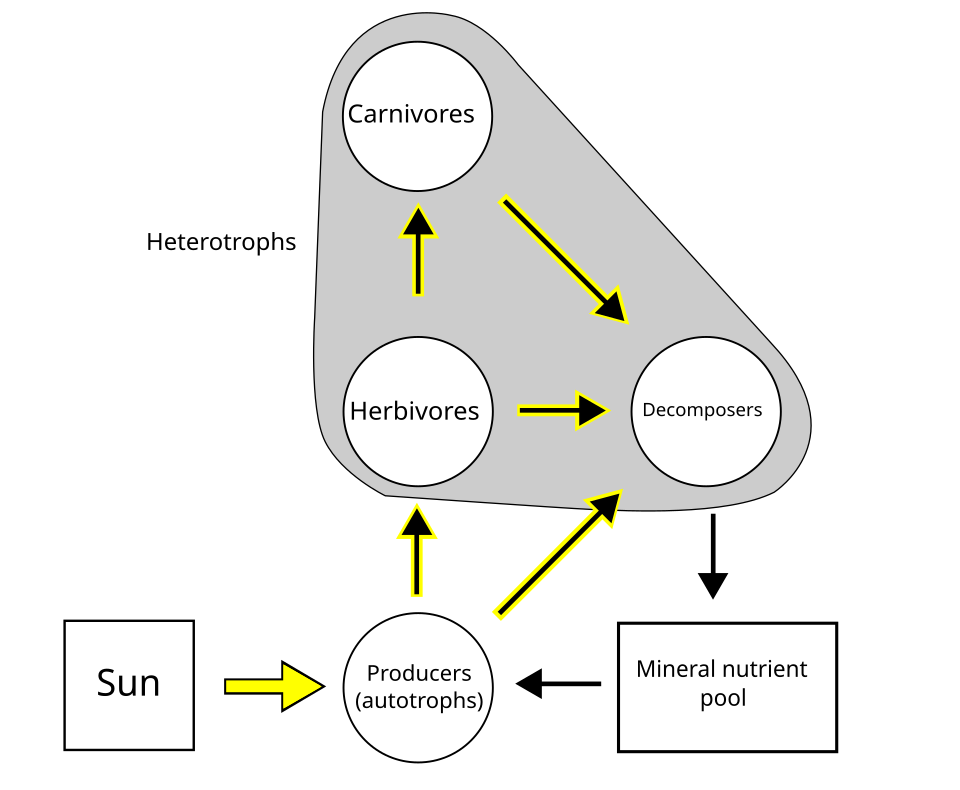
Energy in an ecosystem flows in one direction—from the sun to producers, then to various categories of consumers—while nutrients are recycled in a cyclical manner. This energy-transfer pathway is called a food chain.
📐 Example of a Simple Food Chain – Formula/Process: Grass (producer) → Grasshopper (primary consumer) → Frog (secondary consumer) → Snake (tertiary consumer) → Eagle (quaternary consumer)
In real nature, organisms aren't part of just one food chain—many food chains interconnect to form a complex network called a food web. This network makes ecosystems more stable and resilient—if one food source is depleted, organisms can switch to another.
Energy flow – from the sun through producers, herbivores, carnivores and decomposers and back to mineral nutrient reserves
10% Law
According to this law, formulated by ecologist Raymond Lindeman, on average only 10% of energy is transferred from one trophic level of a food chain to the next—the remaining 90% is lost through respiration, movement, and heat. This is why food chains usually have no more than 4–5 trophic levels, and the population of top predators (e.g., tigers, eagles) is always much smaller than that of producers.
If 10,000 kilocalories of energy are stored in producers (grasses) in a grassland, the herbivore (grasshopper) will receive only about 1,000 kilocalories, the carnivore (frog) only 100 kilocalories, and the apex predator (snake/hawk) only 10 kilocalories. This same mathematical law explains why herbivore food chains in nature are much more energy-efficient than carnivorous ones—a principle also relevant to human diets and food security policy (see Chapter 7).
◆ Food chain ◆ food web ◆ Nutritional level ◆ 10% rule ◆ Raymond Lindemann ◆ energy flow
3 Types of ecosystems – terrestrial and aquatic
Ecosystems on Earth are broadly divided into two categories—terrestrial and aquatic, which are further divided into several subtypes.
| Type of ecosystem | Characteristics and examples |
|---|---|
| Forest ecosystem | High biodiversity; examples: tropical rainforests, Ranthambore and Sariska forests of Rajasthan |
| Grassland ecosystem | Low rainfall, extensive grassland; examples: savanna, oran lands of Rajasthan |
| Desert Ecosystem | Extremely low rainfall, specially adapted organisms; example: Thar Desert |
| Mountain ecosystem | Climate and vegetation vary with altitude; example: Aravalli mountain range |
| Freshwater ecosystem | River, lake, pond; examples: Chambal River, Pichola Lake |
| Marine ecosystem | Brackish water, tidal zone, coral reef; example: Gujarat-Maharashtra coastal region |
The Aravalli mountain range, one of the oldest fold mountain ranges in the world, runs through Rajasthan and acts as a natural barrier to prevent the Thar Desert from expanding eastward – which is why conservation of the Aravallis is considered vital for the ecological stability of Rajasthan (detailed in Topic 13).
◆ Terrestrial ecosystem ◆ aquatic ecosystem ◆ grassland ◆ desert ecosystem ◆ Aravalli mountain range ◆ forest land
4 Biogeochemical cycles – carbon, nitrogen and water cycles
Biogeochemical cycles are the natural processes by which essential elements on Earth (carbon, nitrogen, water, etc.) are continuously cycled between living organisms, the atmosphere, the hydrosphere, and the lithosphere—these cycles make life possible indefinitely, because matter is not destroyed, but merely transformed and transferred from one form to another.
Carbon Cycle
🖼️ Global carbon cycle — flow of carbon (in gigatons) between the atmosphere, vegetation, soil, oceans, and fossil fuel reserves
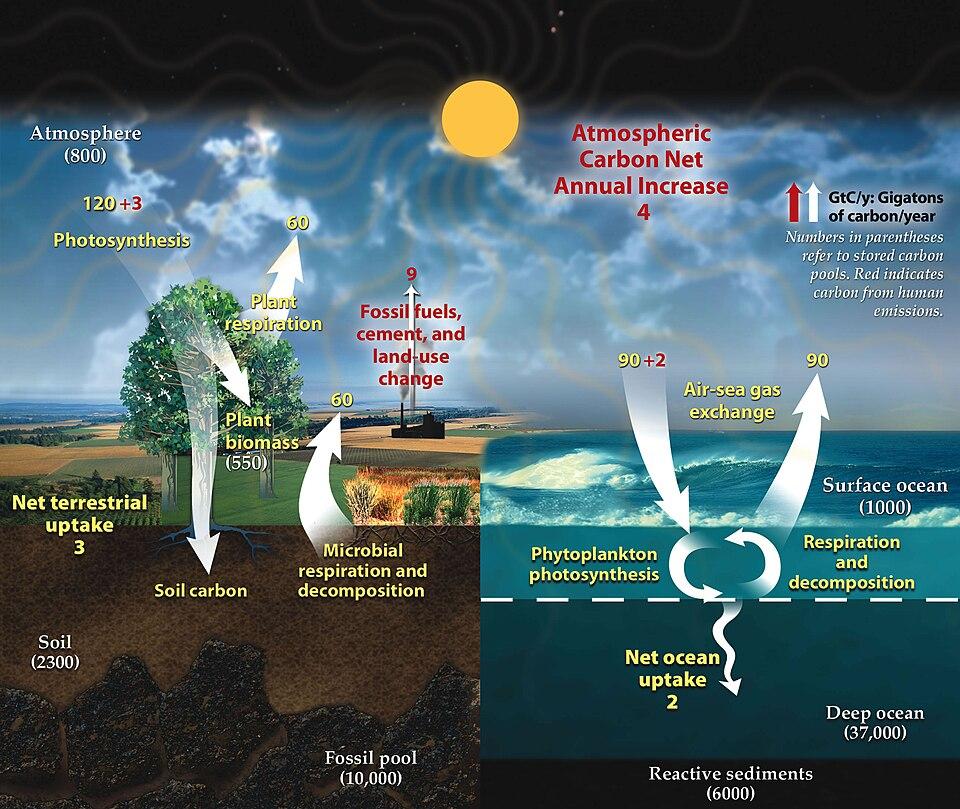
During photosynthesis, plants absorb carbon dioxide (CO₂) from the atmosphere and convert it into organic compounds; this carbon is returned to the atmosphere as CO₂ during respiration, combustion (burning fossil fuels), and decomposition. Since the Industrial Revolution, human activities (combustion of coal, petrol, and natural gas) have significantly disrupted this cycle—more carbon is being emitted into the atmosphere than can be naturally absorbed, which is the root cause of climate change (detailed in the next topic).
Nitrogen Cycle – A Brief Review
About 78% of the atmosphere is nitrogen gas, but most organisms cannot use it directly. Biological nitrogen-fixing bacteria such as Rhizobium (see Chapter 9) convert it into a form usable by plants, which moves through the food chain, and is eventually returned to the atmosphere through decomposition and denitrification.
Water Cycle – A Brief Review
The sun's heat evaporates water from oceans, rivers, and lakes, forming clouds that return to the earth as rain—this water returns to groundwater, rivers, and then the oceans, completing the cycle. For an arid state like Rajasthan, any disruption to the water cycle (such as erratic rainfall patterns) has a direct and serious impact on water security (detailed in Topic 13).
◆ Biogeochemical cycles ◆ carbon cycle ◆ nitrogen cycle ◆ water cycle ◆ Vinitrification ◆ evaporation
5 Climate Change – Causes and Greenhouse Effect
The greenhouse effect is essentially a natural and life-supporting process—if it weren't there, the Earth's average temperature would be around -18°C, too cold for life. Certain gases in the atmosphere (carbon dioxide, methane, nitrous oxide, water vapor) partially trap heat from the Sun from escaping into space, keeping the Earth's temperature habitable (about 15°C on average)—much like a glass greenhouse prevents heat from escaping.
🖼️ Greenhouse gases keep the Earth's surface warm by redirecting long-wave radiation — without greenhouse gases, the temperature would be -18°C, currently 15°C
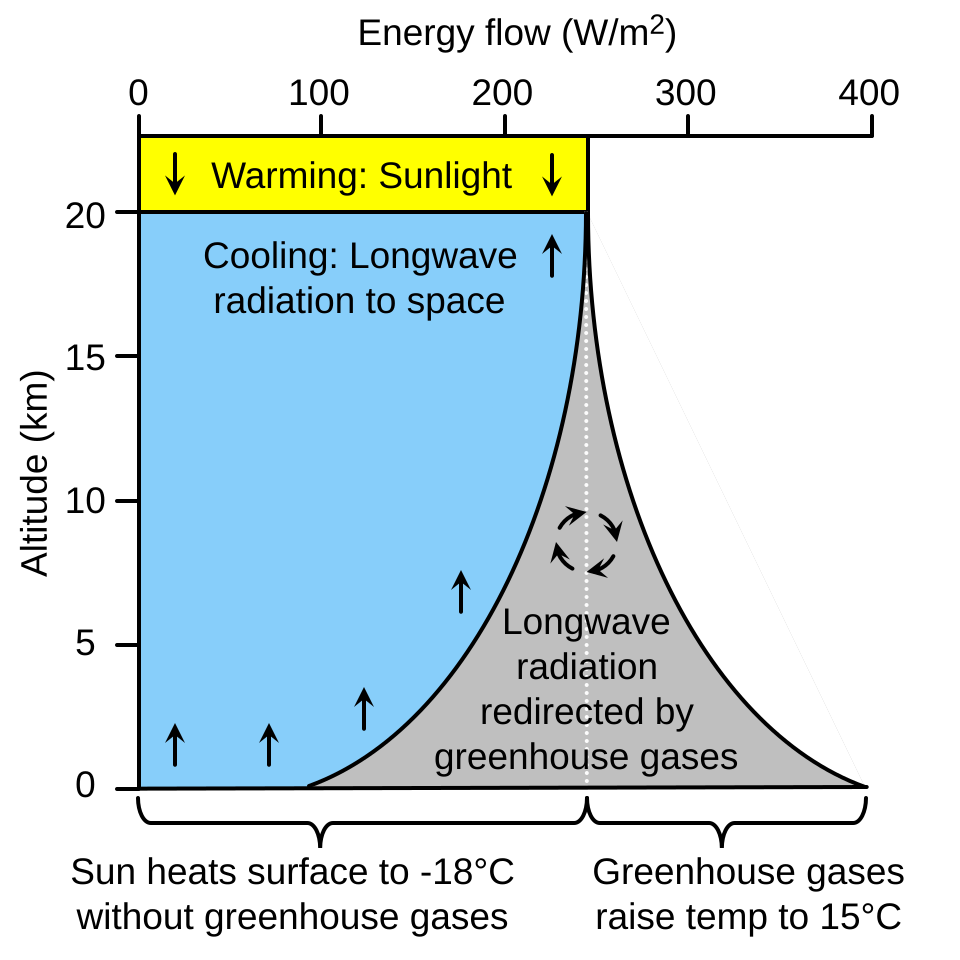
The problem isn't the greenhouse effect itself, but rather its excessive amount. Since the Industrial Revolution (around 1850), human activities—fossil fuel combustion, deforestation, industrial processes, intensive agriculture—have dangerously increased the concentration of greenhouse gases in the atmosphere, leading to abnormally high Earth temperatures—a phenomenon known as global warming and, more broadly, climate change.
| major greenhouse gases | Main sources |
|---|---|
| Carbon dioxide (CO₂) | Fossil fuel combustion, deforestation, cement production |
| Methane (CH₄) | Rice cultivation, animal husbandry (digestion of cattle), landfill waste |
| Nitrous Oxide (N₂O) | Excessive use of nitrogen fertilizers, industrial processes |
| Chlorofluorocarbons (CFCs) | Refrigerators, air-conditioners, aerosols (now banned in most countries) |
◆ greenhouse effect ◆ greenhouse gases ◆ global warming ◆ carbon dioxide ◆ methane ◆ nitrous oxide ◆ CFC
6 Climate Change – Global and Indian Impacts
The impact of climate change is no longer just a future concern, but a present reality – its effects are clearly visible globally and in India.
Global impact
- Temperature rise: The Earth's average temperature has risen by about 1.1–1.2°C since the Industrial Revolution, and at the current pace it could rise by 2.5–3°C by 2100.
- Melting glaciers and sea level rise: Polar ice and mountain glaciers (such as the Himalayas) are melting rapidly, causing sea levels to rise and increasing the risk of coastal areas and island nations being submerged.
- Extreme weather events: More frequent and intense cyclones, droughts, floods and heat waves.
- Biodiversity loss: Many species are facing the threat of extinction due to changing temperatures and habitat loss.
Impact on India
- Monsoon vagaries: Unpredictable changes in rainfall patterns—extreme floods, prolonged droughts.
- Melting Himalayan glaciers: Water sources of major rivers like Ganga, Yamuna, Brahmaputra in danger.
- Threat to coastal areas: Coastal metropolises like Mumbai, Chennai, Kolkata may be affected by sea-level rise.
- Impact on agriculture: Irregular monsoons and rising temperatures affect crop productivity, especially in rain-fed agricultural areas.
At the COP30 conference held in Belém, Brazil, in November 2025 (the 10th anniversary of the Paris Agreement), India announced that it had achieved its 50% non-fossil energy capacity target ahead of schedule (2030)—a significant testament to India's clean energy commitment. The conference agreed to triple the climate-adaptation fund for developing countries, although no formal agreement was reached on fossil fuels and deforestation.
◆ Global warming 1.1°C ◆ Glacial melting ◆ sea level rise ◆ extreme weather events ◆ Monsoon irregularities ◆ COP30 Belem ◆ 50% non-fossil energy target
7 Air pollution – sources, effects and control
Air pollution refers to the presence of harmful substances (gases, dust particles) in the atmosphere that are detrimental to human health, vegetation, and the environment. Many Indian cities are among the most polluted in the world, with air quality in northern India reaching severe levels, especially during winter.
| pollutants | Main sources | Health Effects |
|---|---|---|
| Fine particles (PM2.5, PM10) | Vehicle emissions, construction work, stubble burning | Respiratory and heart diseases, lung cancer |
| Sulfur dioxide (SO₂) | Coal burning, industrial units | Respiratory tract irritation, acid rain |
| Nitrogen oxides (NOx) | Vehicle emissions, power plants | Lung damage, smog formation |
| Carbon monoxide (CO) | Incomplete combustion (vehicles, stoves) | Decreased oxygen carrying capacity of the blood |
Air pollution control measures
- Promotion of clean energy sources (solar, wind); BS-VI emission standards for vehicles and promotion of electric vehicles.
- National Clean Air Programme (NCAP): Launched in 2019, aims to reduce PM concentrations by 40% by 2026.
- Strict enforcement of industrial emission standards and expansion of air quality monitoring system (AQI).
◆ air pollution ◆ PM2.5/PM10 ◆ sulfur dioxide ◆ National Clean Air Programme ◆ AQI ◆ BS-VI standard
8 Water and soil pollution
Water pollution and soil pollution are serious problems affecting two other important components of the ecosystem – water and land – which have a direct impact on food security and human health (see Chapters 7 and 8).
Major sources of water pollution
- Industrial Effluents: Chemical waste from factories released directly into rivers without treatment.
- Domestic sewage: Untreated sewage from urban areas flowing into rivers and lakes – most of India's major rivers (including the Ganga and Yamuna) are affected by this.
- Agricultural Runoff: Excessive use of chemical fertilizers and pesticides, which flow into water sources with rainwater – this causes eutrophication (uncontrolled growth of algae due to excess nutrients and lack of oxygen).
Major sources of soil pollution
- Excessive use of chemical fertilizers and pesticides – damages the natural fertility and microbial diversity of the soil.
- Unsafe disposal of industrial and mining waste – accumulation of heavy metals (lead, cadmium, mercury) in the soil.
- Plastic waste – which takes hundreds of years to decompose naturally – affects the water-holding capacity and fertility of the soil.
💡 Eutrophication — a chain of ecological damage: When agricultural runoff containing excess nitrogen and phosphorus reaches a lake or pond, it causes a rapid growth of algae (algal bloom) – it covers the surface of the water, blocking sunlight from reaching aquatic plants, and when the algae die, their decomposition consumes large amounts of oxygen, leading to the death of fish and other aquatic life from oxygen starvation – demonstrating how an imbalance in one part of the ecosystem can affect the entire chain.
◆ water pollution ◆ industrial waste ◆ Eutrophication ◆ soil pollution ◆ Heavy metal accumulation ◆ plastic waste
9 Environmental Impact Assessment (EIA) – Process and Importance
Environmental Impact Assessment (EIA) is a scientific and regulatory process that assesses the potential impact of a major development project (such as a dam, highway, industrial unit, mining) on the environment, biodiversity, and local communities before granting permission, in order to strike a balance between development and environmental protection.
📐 EIA Process in India (Four Steps) – Formula/Process: Step 1 – Screening: Category of the project (Category A – evaluation at the central level, Category B – at the state level) Step 2 — Scoping: Determination of the study's scope and terms of reference by the Expert Appraisal Committee (EAC) Step 3 — Public Consultation: Hearing and receiving feedback from affected local communities and stakeholders Step 4 – Appraisal: Granting or refusing environmental clearance after a complete appraisal by the EAC
Legal basis of EIA in India and recent update (2025):EIA in India is governed by the EIA Notification 2006 under the Environment (Protection) Act 1986. In March 2025, the Ministry of Environment abolished the previous exemptions granted to linear infrastructure projects (roads, pipelines), and the Environment Audit Rules, 2025, which mandate systematic scrutiny of environmental compliance, came into effect in August 2025. In February 2025, the Supreme Court also stayed the exemptions granted to certain project categories (industrial sheds, schools, colleges) – indicating that India's EIA regime is being strengthened.
◆ THIS IS IT ◆ Environment Protection Act 1986 ◆ EIA Notification 2006 ◆ Screening ◆ Scoping ◆ public consultation ◆ environmental clearance ◆ Environmental Audit Rules 2025
10 India's Environmental Policy and Legal Framework
India has developed a comprehensive legal and institutional framework for environmental protection, which has been strengthened from time to time in response to changing challenges.
| Law/Institution | Year | Objective |
|---|---|---|
| Wildlife Protection Act | 1972 | Conservation of wildlife species and their habitats |
| Water (Prevention and Control of Pollution) Act | 1974 | Pollution control in water sources |
| Forest Conservation Act | 1980 | Control on non-forestry use of forest land |
| Air (Prevention and Control of Pollution) Act | 1981 | Air pollution control |
| Environment (Protection) Act | 1986 | Umbrella law enacted after the Bhopal gas tragedy; the basis of EIA |
| National Green Tribunal (NGT) | 2010 | Special Tribunal for Speedy Settlement of Environmental Disputes |
| Biodiversity Act | 2002 | Conservation of biological resources and traditional knowledge (see Chapter 14) |
Bhopal Gas Tragedy – The Mother of India's Environmental Law:In December 1984, a leak of toxic methyl isocyanate gas from the Union Carbide pesticide factory in Bhopal killed thousands of people—one of the world's worst industrial tragedies. In response to this tragedy, the Indian government enacted the Environment (Protection) Act in 1986, which remains the cornerstone of all environmental regulation in India.
◆ Wildlife Protection Act 1972 ◆ Environment Protection Act 1986 ◆ National Green Tribunal (NGT) ◆ Bhopal Gas Tragedy ◆ Biodiversity Act 2002
11 Global environmental agreements – Paris Agreement and COP conference
Climate change is a global challenge that cannot be solved by the efforts of any one country – that is why several international climate agreements have been reached under the leadership of the United Nations.
Major global agreements
- Kyoto Protocol (1997): The first global agreement to set legally binding emissions reduction targets for developed countries.
- Paris Agreement (2015): Aims to limit global temperature rise to well below 2°C above pre-industrial levels, preferably 1.5°C – each country sets its own Nationally Determined Contributions (NDCs).
- COP (Conference of Parties): An annual global conference held under the United Nations Framework Convention on Climate Change (UNFCCC) where decisions on climate policy are made.
💡 COP30, Belém (November 2025) — 10th anniversary of the Paris Agreement: The COP30 summit (10-22 November 2025) in Belém, Brazil, marked a decade since the Paris Agreement. While the summit agreed to triple climate-adaptation funding for developing countries and made progress on adaptation indicators, no formal global agreement was reached on the phase-out of fossil fuels and halting deforestation—reflecting the significant gap that remains between ambition and actual implementation in global climate diplomacy.
◆ Kyoto Protocol ◆ Paris Agreement 2015 ◆ NDC ◆ UNFCCC ◆ COP conference ◆ COP30 Belem
12 Desertification – Global and Indian Perspectives
Desertification is the process by which the productive capacity of arid, semi-arid, and sub-humid lands gradually declines due to climate change and human activities (overgrazing, deforestation, unbalanced irrigation, inappropriate agricultural practices), eventually turning the land into a desert-like barren state. This is distinct from the 'expansion' of actual desert across a landmass—it is the gradual erosion of existing fertile land.
| major causes of desertification | Description |
|---|---|
| Overgrazing | When the number of animals exceeds the carrying capacity of the land, the vegetation cover gets destroyed. |
| Deforestation | Roots lose their ability to hold soil together, increasing erosion |
| unbalanced irrigation | Increase in soil salinity due to excessive irrigation |
| Climate change | Irregular rainfall, rising temperatures, prolonged drought |
| Wind and water erosion | Blowing away of the upper fertile soil layer |
According to reports from the Indian Space Research Organization (ISRO), approximately 30% of India's total geographical area is affected by some form of land degradation or desertification. Rajasthan, Gujarat, Maharashtra, Karnataka, and Jammu and Kashmir are among the most affected states—among these, Rajasthan's situation is considered the most severe, as the Thar Desert covers a large portion of the state (detailed discussion in the next topic).
◆ desertification ◆ overgrazing ◆ soil salinity ◆ ISRO Land Degradation Report ◆ United Nations Convention to Combat Desertification (UNCCD)
13 Environmental challenges of Rajasthan – desertification, water crisis and air pollution
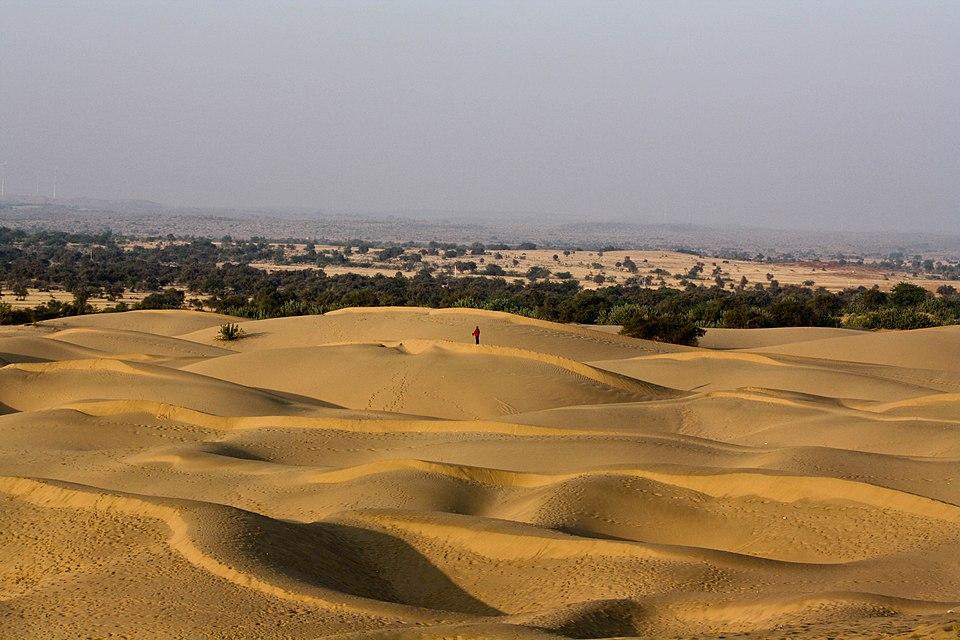
Rajasthan, India's largest state (by area), faces some of the country's most severe environmental challenges due to its unique geographical location—about 60% of the state's land area lies within the Thar Desert, making it one of the most densely populated deserts in the world.
🖼️ Thar Desert of Rajasthan – sand dunes and vegetation lines coexist, showing the dynamic process of desertification and land use change
Current status of desertification (latest data)
- A positive sign: Rajasthan is the only state in the drylands to have recorded a reduction of about 387,000 hectares in the area of land degradation since 2003-05 – a major reason for this is the gradual conversion of sandy lands to crop-production systems.
- Yet concerns remain: About 20.53% of the state's land area is found to be moderately, 11.67% highly and 6.65% extremely vulnerable to desertification – this vulnerability is particularly high in the southern and eastern parts of the state.
- Wind erosion is the biggest cause of land degradation in western Rajasthan, accounting for about 56% of the total land eroded there.
- Interesting changes: Rainfall patterns in western Rajasthan have changed in recent years—with some arid areas experiencing unusually high rainfall and increased flooding, reflecting the complex and sometimes contradictory impacts of climate change.
Water crisis
Rajasthan is India's most water-scarce state—it covers approximately 10.4% of the country's total geographical area, but has only 1.16% of the country's total water resources. Overexploitation of groundwater (especially for irrigation) has led to dangerously low groundwater levels in many districts of the state.
air pollution
Major cities in Rajasthan, such as Jaipur, Jodhpur, and Kota, are also affected by vehicle emissions, construction activities, and industrial pollution—deteriorating air quality, especially in winter. Natural dust storms in desert regions pose an additional challenge.
◆ Thar Desert covers 60% of the land area ◆ Reduction of land degradation ◆ Desertification susceptibility ◆ wind erosion ◆ water-scarce states ◆ groundwater exploitation ◆ dust storms
14 Rajasthan's environmental conservation efforts and solutions
Despite these serious challenges, Rajasthan has developed several effective environmental conservation models by combining centuries-old traditional knowledge and modern technology, which are appreciated at the national and international levels.
traditional water conservation systems
- Johad: A traditional rainwater harvesting structure in Rajasthan—small earthen dams that store rainwater and raise groundwater levels. Through the efforts of Rajendra Singh (known as the "Water Man") and the Tarun Bharat Sangh, hundreds of johads in the Alwar region were revived, restoring many dying rivers (such as the Arvari).
- Stepwell and Tanka: Underground water storage structures that have been used for centuries to collect rainwater in arid regions.
- Oran: Sacred village forest land, which is community-owned – a unique Rajasthani model of traditional 'community forest conservation', which plays an important role in biodiversity conservation.
Modern conservation initiatives
- Aravalli Green Wall Project: An ambitious project to combat desertification by carrying out large-scale tree plantation in the degraded parts of the Aravalli mountain range, inspired by the famous 'Great Green Wall' of Africa.
- Solar and wind energy expansion: Rajasthan, with its abundant sunshine and open desert terrain, has become one of India's largest solar energy producers—the Bhadla Solar Park (Jodhpur) is among the largest solar parks in the world. This clean energy expansion directly contributes to climate change mitigation.
- Desert Development Programme: A joint initiative of the Central and State Governments, which promotes sustainable development, pasture management and soil conservation in desert districts.
- Social Forestry Schemes of Forest Department Rajasthan: Tree Plantation and Forest Conservation Programmes with the participation of rural communities.
💡 Rebirth of the Arvari River – An Inspiring Example: The Arvari River in Alwar district, which had been dry for decades, began flowing again in the 1990s thanks to hundreds of johads built by the Tarun Bharat Sangh. This success not only improved local agriculture and drinking water supplies, but also earned worldwide recognition as a model of community-based water conservation. Rajendra Singh was awarded the Ramon Magsaysay Award in 2001 and the Stockholm Water Prize (considered the Nobel Prize of the water sector) in 2015 for this work.
Rajasthan's environmental challenges and solutions are both crucial for the RAS exam – linking traditional knowledge like Johad/Oran with modern scientific concepts (like water cycle, desertification) while writing answers enhances the quality of the answer – it shows that Rajasthan's traditional knowledge can provide relevant solutions to today's global environmental challenges as well.
◆ Johad ◆ Rajendra Singh ◆ Tarun Bharat Sangh ◆ Arvari River ◆ Oran ◆ Aravalli Green Wall ◆ Bhadla Solar Park ◆ Desert Development Programme
• Ecosystems are formed by the interaction of biotic and abiotic components; energy flows unidirectionally in the food chain/web (10% rule), while nutrients are recycled cyclically (carbon, nitrogen, water cycles). • The greenhouse effect is a natural and life-saving process, but anthropogenic excess greenhouse gases (CO₂, methane, N₂O) have led to global warming and climate change, the effects of which are clearly visible on monsoons, glaciers and extreme weather events. • Air, water and soil pollution affect all three major components of the ecosystem – phenomena such as eutrophication show that an imbalance can affect the entire food chain. • EIA is the scientific assessment of environmental impact before permitting a development project (screening → scoping → public consultation → approval); further strengthened in India in 2025 (Environment Audit Rules). • The Environment Protection Act, 1986, enacted after the Bhopal Gas Tragedy (1984), forms the cornerstone of India's environmental legal framework; the NGT is a special tribunal for speedy resolution of environmental disputes. • The Paris Agreement (2015) aims to limit global warming to 1.5–2°C; at COP30 (Belém, 2025), India announced its intention to achieve the 50% non-fossil energy target ahead of schedule. • Desertification is the gradual loss of land's productive capacity; approximately 30% of India's land area is affected, with Rajasthan among the most vulnerable states. • 60% of Rajasthan's land area lies within the Thar Desert; although land degradation has recently decreased, approximately 39% of the land remains vulnerable to desertification, and the state also faces water stress and air pollution. • Traditional Rajasthani water conservation systems like johads, baoris, tankas and orans have proven to be effective solutions to modern environmental challenges – the rebirth of the Arvari River is an inspiring example. • Modern initiatives like the Aravalli Green Wall Project and Bhadla Solar Park are making Rajasthan a leading state in both environmental protection and clean energy.