- Root – Types, Areas, Transformations and Functions
- Internal structure of root - Dicot and monocot roots
- Stem – Characteristics, Types and Modifications
- Internal structure of stem, secondary growth and annual rings
- Leaf — Parts, venation, types and leaf arrangement
- Internal structure and modifications of the leaf
- Flower – Structure and Parts
- Inflorescence – Types
- Fruit – Types and Structure
- Seed – Structure and Germination
Imagine standing beneath a giant banyan tree—the Great Banyan Tree, located near Kolkata, over 200 years old. This tree is so massive that its canopy spans over 400 meters. To support it, approximately 1,600 roots have descended from its branches into the ground, forming thick pillars—so numerous that, from a distance, it appears not just a single tree, but an entire forest! These roots are what scientifically call "prop roots"—ordinary roots that have abandoned their normal function (absorbing water) and taken on an entirely new function of providing support. Similarly, the potato in your kitchen is not a root, but a stem that has swelled to store food underground. Ginger is also a stem, not a root! This means that every part of a plant—root, stem, leaf, flower, fruit—can change both its form and function as needed, much like a skilled craftsman who uses the same tool in different ways in different situations. Let's understand in detail the structure, function, and use of each of these plant parts—root, stem, leaf, flower, fruit, and seed.
1 Root – Types, Areas, Transformations and Functions
When a seed germinates, the first organ to emerge is called the radicle—this is what later grows to become the root. The root is the underground part of a plant that is generally not green (because it lacks chlorophyll), and lacks nodes, internodes, leaves, or buds. The root exhibits three distinct properties: it is positively geotropic, meaning it grows downward in the direction of gravity, positively hydrotropic, meaning it grows toward water, and negatively phototropic, meaning it moves away from light. These three characteristics are the surest criteria for identifying any organ as a root.
Types of Root Systems
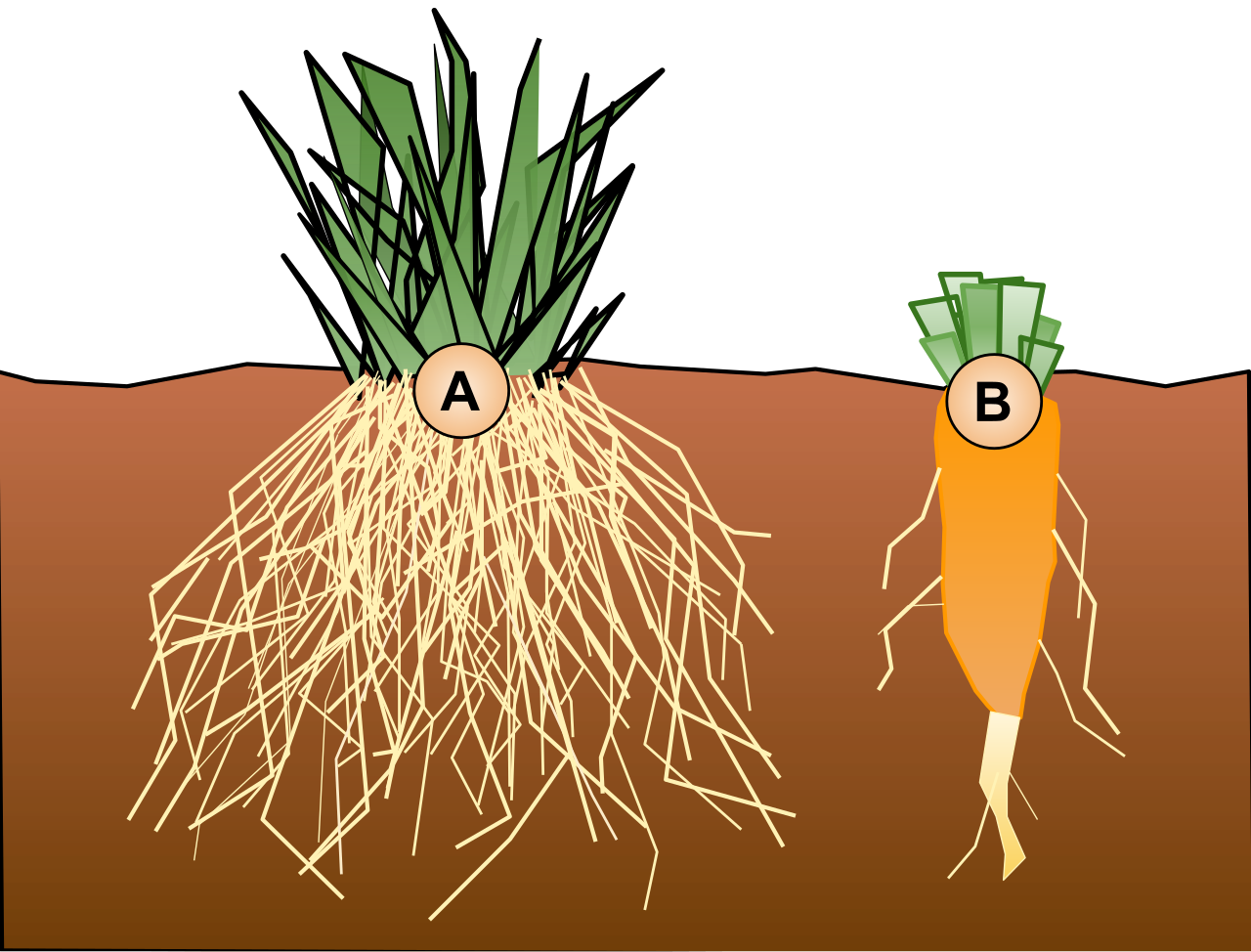
- Tap Root System—Develops directly from the radicle and continues to grow as the primary root, giving rise to secondary and tertiary lateral roots. Deep and strong, it provides a firm anchorage for the plant. This is a key characteristic of dicotyledonous plants—such as chickpea, China rose, and neem.
- Fibrous/Adventitious Root System — In this, the primary root ends very early, and a tuft of thin, threadlike roots emerge from the base of the radicle or plumule. It is shallow and spreads horizontally in the soil, so it does not provide a strong base, but it is very effective in preventing soil erosion. It is a key characteristic of monocot plants — such as maize, wheat, and grasses.
Adventitious roots are roots that develop from any part of the plant other than the radicle—such as from a node in money plant and bamboo, from the base of the stem from a cutting in rose, and from a branch in banyan tree.
Regions of Root
A longitudinal section of the root reveals four distinct regions—from the apex to the base—in this order:
- Root Cap Region — This is a ring-shaped, cap-like structure that is continuously formed by the meristem. It protects the apical meristem from friction and damage by soil particles—much like the protective cap on the front of a drill. In aquatic plants (e.g., Pistia, Water Hyacinth), it is found as a loose 'root sac'.
- Region of Meristematic Activity—This is a small region of the apical meristem whose cells are continuously dividing. It has three layers—the dermatogen (outer, from which the epiblema and root cap are formed), the periblemma (from which the cortex is formed), and the plerom (central, from which the stele is formed).
- Region of Elongation – The cells in this region rapidly increase in size (elongate), which is why the actual increase in the length of the root occurs.
- Maturation Zone: Here the cells differentiate into their final form. It has two subdivisions: the root hair zone (where unicellular root hairs form and absorb water and minerals) and the permanent (hairless) zone behind it, from which lateral roots arise.
In 1958, Clowes discovered a bowl-shaped reservoir of dormant cells in the root tip of maize, between the root cap and the active meristem, called the 'quiescent centre' – it normally remains dormant, but if the main meristem is damaged, it activates and compensates for it – that is, it acts as an 'emergency backup system' of the root.
🖼️ Taproot system (left) and adventitious root system (right)
Modifications of Roots
Roots aren't limited to absorbing water—they completely change their shape and function as needed. These are divided into two broad categories—taproot modifications and adventitious root modifications.
(a) Modifications of tap root – for storing food
| Type | Speciality | Example |
|---|---|---|
| Conical | base broad, gradually tapering | Carrot |
| Fusiform | Swelling in the middle, tapering at both ends | radish |
| Kumbhi form (Napiform) | rounded base, tapering tip | turnip |
| Tuberous | Thick-fleshed, no definite shape | Gul-Abbas (4 O'Clock Plant) |
(b) Modifications of adventitious root
- For food storage – tuberous (sweet potato), fasciculated (dahlia), nodulose (mango-ginger), moniliform (grass), annulated (ipecock).
- For photosynthesis – Assimilatory roots, which turn green in sunlight and make food – like the aerial roots of Tinospora.
- To absorb atmospheric moisture – epiphytic roots, which have a green spongy layer called velamen – like orchids (Vanda).
- Pneumatophores, which grow vertically upwards and have pores at their tips to help in breathing – in marsh and coastal mangrove plants (e.g. Rhizophora).
- For parasitic nutrition – sucking roots/Haustoria, which penetrate the host plant and suck food directly from its phloem – like Cuscuta, which is a parasite completely dependent on another plant.
- For strong support – prop roots (hang from the branches and sink into the ground – banyan, as mentioned in our story), stilt roots (arise diagonally from the nodes at the base of the stem – sugarcane, kewda), climbing roots (used to cling to the support in weak vines – money plant).
- For buoyancy (floating) – floating roots, which are spongy and air-filled – in marsh/aquatic plants (e.g. Jussia).
Functions of roots
- Anchorage—holding the plant firmly in the soil—is a mechanical function.
- Absorption of water and mineral salts and their upward transport – this is a physiological function.
- Special functions through modifications – food storage, photosynthesis, absorption of atmospheric moisture, parasitic nutrition, gaseous exchange, buoyancy and additional strong support.
The Great Banyan Tree near Kolkata is over 200 years old, has a canopy circumference of over 400 metres, and has approximately 1600 prop roots – the largest living example of the tree's modified function of roots.
◆ Radicle ◆ tap root system ◆ fibrous root system ◆ Original Gop ◆ root hair ◆ Calm Center ◆ Velamen ◆ Pneumatophore ◆ haustoria ◆ Columnar roots
2 Internal structure of the root – Dicot and monocot roots
If a transverse section of the root is taken and viewed under a microscope, a very well-organized structure is visible, arranged in layers from outside to inside – just like the layers of an onion, in which each layer has its own specific function.
Primary structure of a dicot root (e.g., gram)
- Epiblema—the outermost, single layer, some of whose cells project outward to form unicellular root hairs—provides both protection and absorption.
- Cortex – Large, multilayered, layer of parenchyma cells containing intercellular spaces – stores food and water.
- Endodermis—the innermost layer of the cortex, composed of barrel-shaped cells with Casparian strips on their radial walls—allows water to enter the xylem through a controlled passage. Some cells, called passage cells, lack this strip and aid in the movement of water.
- Pericycle – A single layer within the endodermis, from which lateral roots, vascular cambium and cork cambium originate.
- Vascular Bundles—Arranged radially; the xylem is exarch, that is, the protoxylem is toward the periphery and the metaxylem toward the center. Depending on the number of xylem plates, they are called diarch to hexarch.
- Pith – very small or absent, because the metaxylem plates are often fused together in the centre.
Primary structure of a monocot root (e.g. maize)
In a monocot root, the epiblema, cortex, and endodermis (including Casparian strips and passage cells) are almost identical to those of a dicot root, but there are three major differences: only lateral roots arise from the pericycle; the cambium is not formed at all; the vascular bundles are numerous and polyarchous; and the pith, which serves as a food store, is large and well developed.
| Base | Dicot root | monocot root |
|---|---|---|
| Number of vascular bundles | Limited (2-6, dioecious to hexaecious) | Many (multiple) |
| role of the beginning | Lateral roots + Vascular cambium + Cork cambium | only lateral roots |
| cambium | Present | absent |
| Secondary growth | it occurs | would not have been |
| Pith | very small or absent | large and well developed |
Origin of lateral roots
Lateral roots are endogenous, meaning they arise from the deeper layer of the root—the pericycle—(rather than from the outer layer, as in stem branches). Pericycle cells located in front of the protoxylem divide to form a projection that penetrates the endodermis and cortex, and differentiates its dermatogen-periblem-pleurome to eventually emerge as an independent lateral root. The number of lateral roots corresponds to the number of xylem plates—e.g., in a tetrachromic root, lateral roots arise from four directions.
Secondary growth in dicot root
This occurs only in dicotyledonous roots, with the help of the vascular cambium and cork cambium (both derived from the pericycle). The cells of the pericycle form a cambium band just outside the protoxylem, and another band of connective tissue forms on the inside of the phloem. These two bands together form a complete ring, initially wavy but later circular. This cambium continues to form secondary xylem on the inside and secondary phloem on the outside. The cork cambium (phyllogen) also forms in the pericycle, which gives rise to the cork (phyllum) on the outside and the secondary cortex (phylloderm) on the inside. Together, these three are called the periderm, which becomes the root's new protective layer, after all the previous outer layers (epiblema, cortex, and endodermis) have shed.
◆ Epiblema ◆ Cortex ◆ Casparian strip ◆ start ◆ Extrinsic xylem ◆ Endogenous origin ◆ Periderm
3 Stem – Characteristics, Types and Modifications
Just as a root develops from a radicle, a stem develops from a plumule. It is positively phototropic, meaning it grows towards light, and negatively geotropic, meaning it grows upwards against gravity—the exact opposite of the root's behavior. The stem is divided into a node (from which a leaf attaches) and an internode (the part between two nodes), and on it are found a terminal bud (at the front end of the stem) and an axillary bud (in the axil of the leaf)—these buds can later become leaves, branches, or flowers.
| Base | Stem | Root |
|---|---|---|
| Produce | from the plumule | from the radicle |
| Colour | young stem green | Not usually green |
| festival-festival | Present | absent |
| leaf and bud | Present | absent |
| follow-up | Light-following, anti-gravity | Gravity-following, anti-light |
| Origin of lateral branches | Exogenous | Endogenous |
Shoot Apex
At the apical end of the stem is a dome-shaped meristem, which is divided into two parts – the tunica (outer, 1-3 layers, divides only anticlinally to form the epidermis and superficial outgrowths) and the corpus (inner, multi-layered, divides in all directions to form the procambium and basal meristem, which further form the vascular tissue and leaf primordia). The development of the lateral branch from the axillary bud occurs exogenously – that is, from the outer layers – which makes it completely different from the endogenous lateral root origin of the root.
Types of stems
- Aerial stem – Herbaceous, shrubby or tree-like, standing erect.
- Sub-aerial – weak, spreading or climbing on the ground.
- Underground stem – buried in the soil, which sends out aerial branches seasonally.
Stem modifications
Three sure signs distinguish an underground stem from a root: it has nodes, scales (leaves without green color), and buds. Their main functions are perennation (remaining dormant during unfavorable weather and sprouting again the following season) and food storage.
| Underground conversion | Speciality | Example |
|---|---|---|
| Rhizome | Thick, fleshy, grows horizontally near the soil surface | Ginger, turmeric |
| Corm | Fleshy, rounded-flattened base, vertical growth | Saffron, Yam, Gladiolus |
| Bulb | Flattened, disc-shaped stem, clustered nodes, fleshy scales | onion |
| glandular tuber | The swollen ends of underground branches are starch storage 'eyes' | Potato |
| Semi-aerial conversion | Speciality | Example |
|---|---|---|
| Runner | Tall, weak, long internodes, spreading horizontally on the soil | grass, oxalis |
| Stolon | It first grows upwards, then bends down and takes root in the soil. | Mint, jasmine |
| Offset | runner-like but shorter, in aquatic plants | water hyacinth |
| Sucker | Underground runner, slanting out to the surface | chrysanthemum |
All these semi-aerial modifications are mainly used for vegetative propagation i.e. for creating new plants without seeds – hence all these plants are mostly creeper in nature.
| Airborne conversion | Speciality | Example |
|---|---|---|
| Stem Tendril | threadlike, coiled, leafless, helps in climbing | grape arbor |
| Thorns | straight, pointed, rigid; metamorphosed from axillary or apical buds; For safety reasons | Lemon, Duranta, Cranberry |
| Phylloid column (Phylloclade) | Green, flat/cylindrical, fleshy stem with internodes, bearing spines (modified leaves) | Hawthorn (Opuntia) |
| Cladode | Foliose stem with limited growth (only 1-2 nodes) | Asparagus |
In the desert cactus, the true leaves are completely transformed into thorns to minimize water loss (transpiration)—and the green, fleshy stem (phylloid column) performs all the photosynthesis. This means that the thick, green, "leaf-like" part of the cactus is actually not a leaf, but a stem!
Functions of the stem
- Main functions – Providing proper position of leaves in the direction of sunlight, transporting water and minerals upwards through xylem and food downwards through phloem, and bearing flowers and fruits.
- Additional functions (by modification) – food storage (potato), hibernation (ginger), vegetative propagation (rose, sugarcane), photosynthesis in dry areas (cactus), protection (thorn), and climbing (stem tendrils).
◆ Plumule ◆ festival-festival ◆ apical bud ◆ orbital bud ◆ rhizome ◆ corms ◆ tuber scales ◆ glandular tubercle ◆ phylloid column
4 Internal structure of stem, secondary growth and annual rings
Primary structure of a dicotyledonous stem (e.g. sunflower)
- Epidermis — The outermost single layer, protective, including the cuticle and multicellular hairs.
- Cortex – It has three sublayers: hypodermis (4-6 layers of calloused tissue, for mechanical strength), middle layers (parenchyma) and endodermis (barrel-shaped cells filled with starch granules, hence also called 'starch sheath').
- Stele – pericycle (multi-layered parenchyma and sclerenchyma), vascular bundles (arranged in a ring, each joint, collateral and open – i.e. cambium present between xylem and phloem; xylem endarch i.e. protoxylem towards the centre), pith rays (parenchyma between bundles) and pith (central parenchyma region).
Primary structure of a monocot stem (e.g. maize)
The epidermis lacks hairs. Ground tissue is an undifferentiated mass of parenchyma, surrounded by a sclerenchymal hypodermis at its periphery. Vascular bundles are numerous and scattered, each surrounded by a sclerenchymal bundle sheath; these are collateral but closed, meaning they lack a cambium. The xylem is shaped like the letter 'Y', and the inner protoxylem collapses to form a water cavity.
| Base | Dicot stem | monocot stem |
|---|---|---|
| vascular bundle | Limited number, in a ring, of equal size | numerous, scattered, varying in size |
| bundle sheath | absent | present (concretion) |
| cambium | Present (open bundle) | Absent (closed bundle) |
| Water cavity | absent | Present |
| Secondary growth | happens (usually) | Usually does not occur |
Secondary growth (only in dicot stem)
The cambium (fascicular cambium) within the vascular bundle and the cambium (interfascicular cambium) formed by the medullary ray cells fuse to form a continuous ring. This cambium continues to produce a large amount of secondary xylem on the inside and a smaller amount of secondary phloem on the outside. Meanwhile, the cork cambium (phyllogen) also develops in the cortex, forming the phelloderm (secondary cortex) on the inside and the phyllum (cork) on the outside. Cork cells are dead, compact, and suberin-containing, with only loose, suberin-containing cells at locations called lenticels, allowing for gas exchange. Phellogen, phyllum, and phylloderm together form the periderm, which replaces the epidermis in older stems. All the dead layers outside the active phyllogen are collectively called bark.
The bark of the birch tree peels off in paper-thin layers, and in ancient times, manuscripts were written on it. The thick cork bark of the cork oak tree is commercially used to make bottle caps, insulation, and shoe soles—this is the same cork we saw in the story of Robert Hooke in the chapter on cells.
Wood, Annual Rings and Dendrochronology
The secondary xylem formed by the activity of the vascular cambium is called 'wood'. In temperate climates, the seasonal activity of the cambium results in the formation of alternating layers of spring wood (wide-vesseled, formed during the more active period) and autumn wood (narrow-vesseled, formed during the less active period), which appear as concentric rings—called annual rings. The age of a tree can be determined by counting these rings—a method called dendrochronology.
| 🟢 Sap Wood | 🟤 Heart Wood |
|---|---|
| ◆ external, functional, newly built ◆ Light colored, vessels open (conduct water) ◆ Less durable, less valuable | ◆ Inner, non-functional, darker due to gum-resin-tannin deposits ◆ Vessels blocked by tylosis (do not conduct water) ◆ Heavier, more durable, more commercially valuable (e.g. teak furniture) |
◆ starch sheath ◆ fascicular cambium ◆ Intercontinental Aidha ◆ Phylogen ◆ Lenticel ◆ Periderm ◆ bark ◆ annual rings ◆ Dendrochronology ◆ sapwood ◆ heartwood
5 Leaf — Parts, venation, types and leaf arrangement
A leaf is a flat, spreading, lateral appendage of a stem or branch that arises from a node and develops from a leaf primordium. Its axillary bud is located within its axillary cavity. The leaf is the primary site where vital processes such as photosynthesis, transpiration, and respiration occur—hence, it can also be called the plant's "kitchen."
parts of the leaf
- Leaf Base—connects the leaf to the node; in monocot plants it expands to form a sheath, while in dicot plants it may bear stipules.
- Petiole – The stalk of a leaf; leaves that have it are called petiolate, while those that do not (most monocots) are called sessile. Sometimes it can be modified by swelling (water hyacinth), becoming winged (orange), or becoming completely flattened like a leaf (Australian acacia).
- Lamina – The green, flat, expanded portion of the leaf, covered with veins and venules; the most prominent vein is called the midrib, which runs from the base to the tip and provides mechanical support for the transport of water, minerals, and food.
Venation
The arrangement of veins and venules in a leaf is called venation. There are two main types: reticulate venation, in which the veins form a net-like structure (characteristic of dicotyledonous plants), and parallel venation, in which the veins run in parallel rows from the base to the tip (characteristic of monocotyledonous plants). Both of these have two subtypes: unicosate (feather-like veins radiate from a main midrib—reticulate in peepal, parallel in canna) and multicosate (multiple veins radiate from a single point, like the fingers of a palm—reticulate in grapevine, parallel in palm).
Types of leaves – simple and compound
If the cut in the leaf blade does not reach the midrib, it is called a simple leaf. If the cut reaches the midrib and completely divides the blade into separate leaflets, it is called a compound leaf. The surest criterion for distinguishing between the two is this: the axil of a complete leaf (or compound leaf) has an axillary bud, but the axil of a single leaflet never has a bud.
| 🟢 Pinnately Compound | Palmately Compound leaf |
|---|---|
| ◆ The leaflets are arranged in rows on either side of an axis (rachis). ◆ Can be further subdivided into unipinnate, bipinnate, and tripinnate. ◆ Example – Neem, Tamarind, Gulmohar | ◆ All the leaflets arise from the same point on the petiole like a palm ◆ According to the number of leaves — dicotyledonous, trifoliate, tetracotyledonous, polycotyledonous ◆ Example – silk cotton, cotton |
Phyllotaxis
The systematic arrangement of leaves on a stem or branch is called phyllotaxy, which is a clever arrangement of nature to allow each leaf to receive maximum sunlight. There are three types of it – Alternate (single leaf on each node – e.g. hibiscus, mango), Opposite (two leaves opposite to each other on each node – this is further divided into two subtypes: Crossed / Decussate in which consecutive pairs are at right angles e.g. basil, and Superposed in which consecutive pairs are in the same plane e.g. guava), and Whorled (more than two leaves in a circular arrangement on a single node – e.g. oleander).
◆ petiole ◆ Leaf stalk ◆ lamina ◆ midrib ◆ reticulate venation ◆ Parallel venation ◆ Simple leaf ◆ Compound leaf ◆ alternate phyllotaxy
6 Internal structure and modifications of the leaf
The internal structure of a leaf consists of three main parts—the epidermis, the mesophyll, and the vascular system. Dicotyledonous leaves are dorsiventral (horizontal orientation, upper and lower surfaces are different), while monocotyledonous leaves are isobilateral (vertical orientation, both surfaces are nearly identical).
Epidermis and Stomata
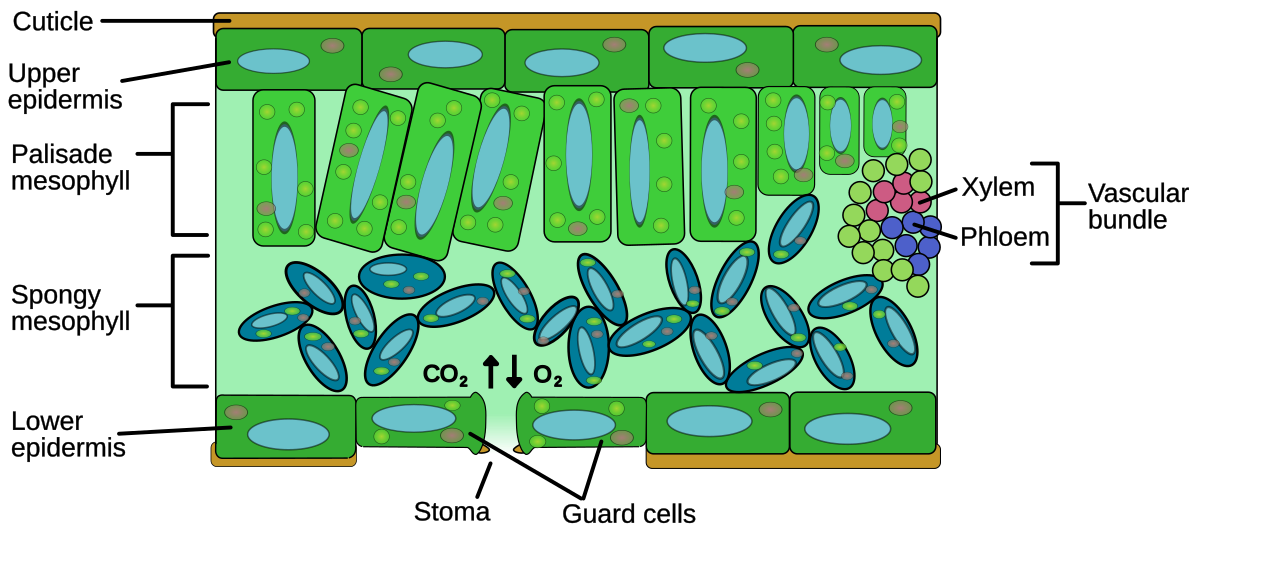
The leaf has an epidermis on both its upper and lower surfaces, some of whose cells transform into guard cells to form stomata – these stomata are the main portals for gas exchange and transpiration. In dicotyledonous leaves, guard cells are reniform and are generally found only on the lower surface, whereas in monocotyledonous leaves (such as maize), they are dumbbell-shaped and are found on both surfaces.
| Plant type | position of stomata | Special note |
|---|---|---|
| Common dicots (mango, neem) | mainly on the lower surface | crescentic/renal guard cells |
| Common monocots (maize) | on both surfaces | dumbbell shaped guard cells |
| Marudbhid (Kaner) | Lower surface only, often sunken | to reduce transpiration |
| Floating leaf hydrophytes (lotuses) | top surface only | Waste on the lower surface due to water below |
| submerged leaf hydrophytes (Hydrilla) | absent | Gas exchange occurs directly with water. |
Mesophyll
This is the chlorophyll-rich chlorophyll, which is the main site of photosynthesis. In dicotyledonous leaves, it is differentiated into two parts – palisade tissue (below the upper epidermis, long, straight, dense cells, abundant chlorophyll) and spongy tissue (below it, irregular and loose cells, less chlorophyll, more intercellular space for gas storage). Monocotyledonous leaves have only spongy tissue, columnar tissue is absent.
Special structures
- Bulliform Cells — Large cells found in the upper epidermis of some monocot leaves, such as maize, millet, and sorghum. They shrink when water is scarce (such as in hot afternoon sun), causing the leaf to curl up—this reduces transpiration, a clever natural water-conserving mechanism.
- Hydathodes—specialized structures found on the leaf margins of some plants (such as garden nasturtiums) in humid climates—expel excess water in the form of liquid droplets—a process called guttation. This occurs when root absorption exceeds leaf transpiration.
Internal structure of the leaf – epidermis, mesophyll and vascular bundles
leaf modifications
- Leaf Tendril – Thin, coiled, for climbing – Pea, Glory Lily.
- Spines – for protection and reducing transpiration – Argemone, cactus, aloe vera.
- Phyllode – The petiole of a compound leaf flattens and becomes leaf-like, the leaflets disappear – Australian Acacia.
- Insectivorous leaves—in the pitcher plant (Nepenthes), the entire leaf becomes pitcher-like; in the bladderwort (Utricularia), the leaf is modified into tiny sacs—both obtain additional nutrition (especially nitrogen) by trapping and digesting insects.
◆ mesophyll ◆ Columnar tissue ◆ spongy tissue ◆ Stomata ◆ bulliform cells ◆ water hole ◆ glottis ◆ leaf tendril ◆ Ghatparni
7 Flower – Structure and Parts
The flower is actually a modified shoot, in which the internodes are so closely packed that the leaf structures (whorls of the flower) appear arranged in a row. It is the center of sexual reproduction in the plant, producing fruit and seeds after fertilization.
parts of a flower
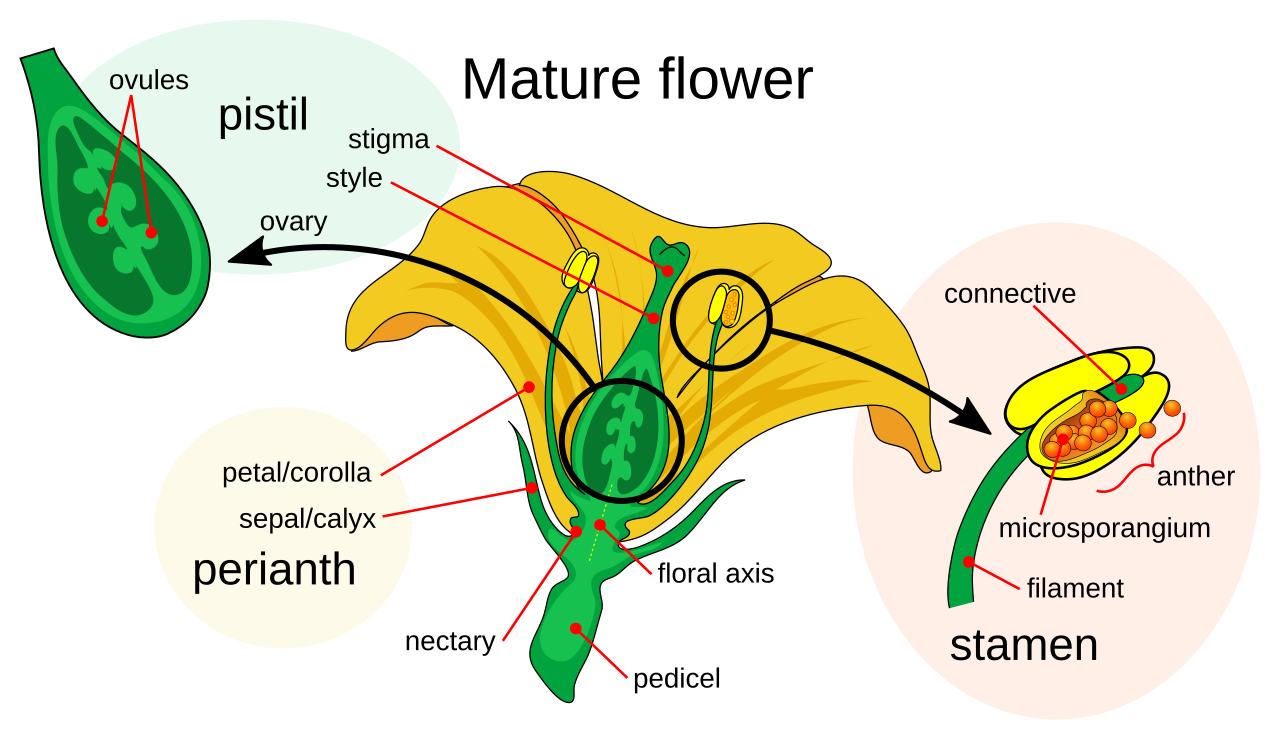
The flower is borne on a stalk—a pedicel—with a swollen end called the thalamus/receptacle, bearing four whorls arranged in succession:
- Calyx – The outermost whorl, its unit is called a sepal; it is usually green and protects the flower in the bud stage.
- Corolla – Its unit is called a petal; it is usually colorful and attractive, attracting pollinators (insects, birds).
- Androecium — The male part of a flower, a cluster of stamens; each stamen consists of a long, thin filament and a bilobed anther at the end, held by a connective tissue. Pollen grains are produced in the anther.
- Gynoecium — The innermost, female part of a flower; a cluster of one or more pistils fused with one or more carpels. Each pistil has three parts—the ovary (the swollen base, the inner chambers of which contain the ovules, which after fertilization become seeds, and the entire ovary develops into the fruit), the style (the tube connecting the ovary to the stigma), and the stigma (the surface that receives pollen grains).
🖼️ Structure of a typical bisexual flower – calyx, corolla, androecium and gynoecium
Variations in flowers
- Complete flower – in which all four whorls are present; Incomplete flower – in which one or more whorls are absent.
- Bisexual – having both stamens and pistils; Unisexual – having only one – anther (stamens only) or gynoecium (pistil only).
- Monoecious – Male and female flowers on the same plant – e.g. cucumber. Dioecious – Male and female flowers on different plants – e.g. papaya.
- Actinomorphic – Can be divided into two equal parts by any vertical plane – Mustard. Zygomorphic – Can be divided equally by only one fixed plane – Pea.
Position of the chakras and position of the ovary on the flower bed
| Type | inflorescence shape | Ovarian condition | Example |
|---|---|---|---|
| Hypogynous | conical, ovary at the top | Superior | Hibiscus, mustard |
| Perigynous | Disc-shaped, ovary in the middle | Half-inferior | peach, plum |
| Epigynous | Cup-shaped, encircling the ovary | Inferior | Sunflower, cucumber |
Placentation
The place where the ovules are attached within the ovary is called the placenta, and its arrangement is called placentation. The main types are – Marginal (one carpel, one ovule, ovules on the margins – pea), Axile (many fused carpels, many lobules, ovules on the central axis – hibiscus, tomato), Parietal (many fused carpels, one ovule, ovules on the inner wall – mustard, cucumber), and Basal (single ovule at the base of the ovary – sunflower).
To remember the four whorls of a flower, remember the order from outside to inside – first the 'security guard' (green sepals), then the 'welcome banner' (the colorful team that attracts insects), then the 'male team' (stamens, which produce pollen), and last of all the 'headquarters' (the gynoecium, where seeds are formed).
◆ Pushpasana ◆ calyx ◆ corolla ◆ stamen ◆ gynoecium ◆ Anther ◆ ovaries ◆ stigma ◆ Underworld ◆ Ovulation
8 Inflorescence – Types
The arrangement of flowers on the floral axis (called the peduncle) is called an inflorescence. There are two major classes of inflorescences: Racemose, in which the main axis is unlimited in growth (it does not terminate at a flower) and the flowers bloom in an acropetal order (the oldest flower at the bottom, the newest at the top); and Cymose, in which the main axis is limited in growth and itself ends in a single flower, and the flowers bloom in a basipetal order (the terminal flower at the top is the oldest).
Types of Racemose Inflorescence
| Type | Speciality | Example |
|---|---|---|
| Asimaksh/Raceme | long axis, stalked flowers | Mustard |
| Spike | racemose, but sessile | Achyranthes (Latjira) |
| Spikelet | cluster of small florets with scales | wheat |
| Catkin | Spike-like, pendulous axis, unisexual flowers | Mulberry |
| Spadix | Fleshy axis covered with a showy spathe | Banana, Arabic |
| Corymb | Short axis, all flowers almost on the same plane | Candytuft |
| Umbel | stems of equal length originating from the same point | Coriander |
| Head | Flattened raised receptacle, sessile florets arranged centripetally | Sunflower |
Types of Cymose Inflorescence
- Monochoasial Cyme – Main axis ends in one flower, only one lateral branch grows forward – cotton.
- Dichasial Cyme – Two lateral branches arise from either side of the terminal flower – Dianthus, Jasmine.
- Polychasial Cyme – Many lateral branches emerge from around the terminal flower – Aak (Calotropis).
Special types of inflorescence
- Hypanthodium – Fleshy inflorescence forms a cup-like cavity, male and female flowers on the inner wall – fig, peepal.
- Cyathium—characteristic of the Euphorbia family; a single female flower surrounded by numerous male flowers in a cup-shaped sheath.
- Verticillaster – Condensed dichotomous panicle on each node in the leaf axil – Basil, Salvia.
◆ inflorescence ◆ peduncle ◆ Infinite ◆ Sasimakshi ◆ forward configurable order ◆ planar order ◆ Spadix ◆ Capitulum ◆ Hypanthodium
9 Fruit – Types and Structure
The structure formed by the maturation of the ovary after fertilization is called a true fruit. During this process, the ovules develop into seeds, and the ovary wall develops into the fruit wall or pericarp. If, in addition to the ovary, other parts of the flower (such as the receptacle) also participate in fruit formation, it is called a false fruit—such as apples and pears (in which the swollen receptacle is the edible part) and figs (in which the receptacle itself resembles the fruit).
Sometimes fruit forms without fertilization, a process called parthenocarpy—fruits that do not produce seeds or remain undeveloped, such as bananas and some varieties of grapes. Horticulturists also cultivate these artificially so that seedless fruits can be available in the market.
Three layers of the pericarp
In fleshy fruits, the pericarp is differentiated into three distinct layers—the epicarp (the outermost peel), the mesocarp (the fleshy-succulent middle part, which is usually edible) and the endocarp (the innermost layer, which is hard/woody in fruits like mango and coconut, while it is thin-membranous in orange). In dry fruits, the pericarp is thin-papery or thick-woody, but is not clearly differentiated into these three layers.
Three Basic Types of Fruits
- Simple Fruit – Formed from a single (single or compound) ovary – Pea, Tomato.
- Aggregate Fruit – A collection of several blades formed from the free carpels of a single flower (multi-carpel, unicarpel, ovary) on the inflorescence – Aak, Ranunculus.
- Composite/Multiple Fruit – Formed from the fusion of several flowers or an entire inflorescence – mulberry, pineapple.
| Social class | Subtypes | Example |
|---|---|---|
| Simple – dry, self-bursting | Legume, silica, follicle, capsule | Peas, mustard, aak, okra |
| Simple – dry, non-cracking | Caryopsis, Nut, Cypsela, Samara | Wheat-rice, almond-cashew, sunflower, yam |
| Simple – fleshy | drupe, berry, pepo, hesperidium, pome | Mango-coconut, tomato-banana, melon, lemon-orange, apple-pear |
| montage | Drupelet-cluster, achene-cluster, berry-cluster | raspberries, strawberries, cilantro |
| joint/bunch | Sorosis, Cyconus | Pineapple-Mulberry-Jackfruit, Fig-Peepal |
💡 Interesting Facts — Are Bananas Good to Eat?: Did you know that when you eat a banana, you're actually eating its mesocarp and endocarp? Similarly, in an apple, the edible part is actually the swollen thalamus—the true ovary is the hard, seed-bearing part in the center of the apple. A pineapple is a composite fruit, formed from an entire inflorescence—so each "eye-like" mark on it is actually the remains of a separate flower!
◆ Pericarp ◆ Epicarp ◆ Mesocarp ◆ Endocarp ◆ false fruit ◆ parthenocarpy ◆ Simple fruits ◆ montage of fruits ◆ Combined fruit
10 Seed – Structure and Germination
After fertilization, the ovule matures to form a seed—a 'protective capsule' for the next generation of plants, within which a tiny plant (embryo) remains dormant until the right conditions (water, temperature, oxygen) are available for germination.
major parts of the seed
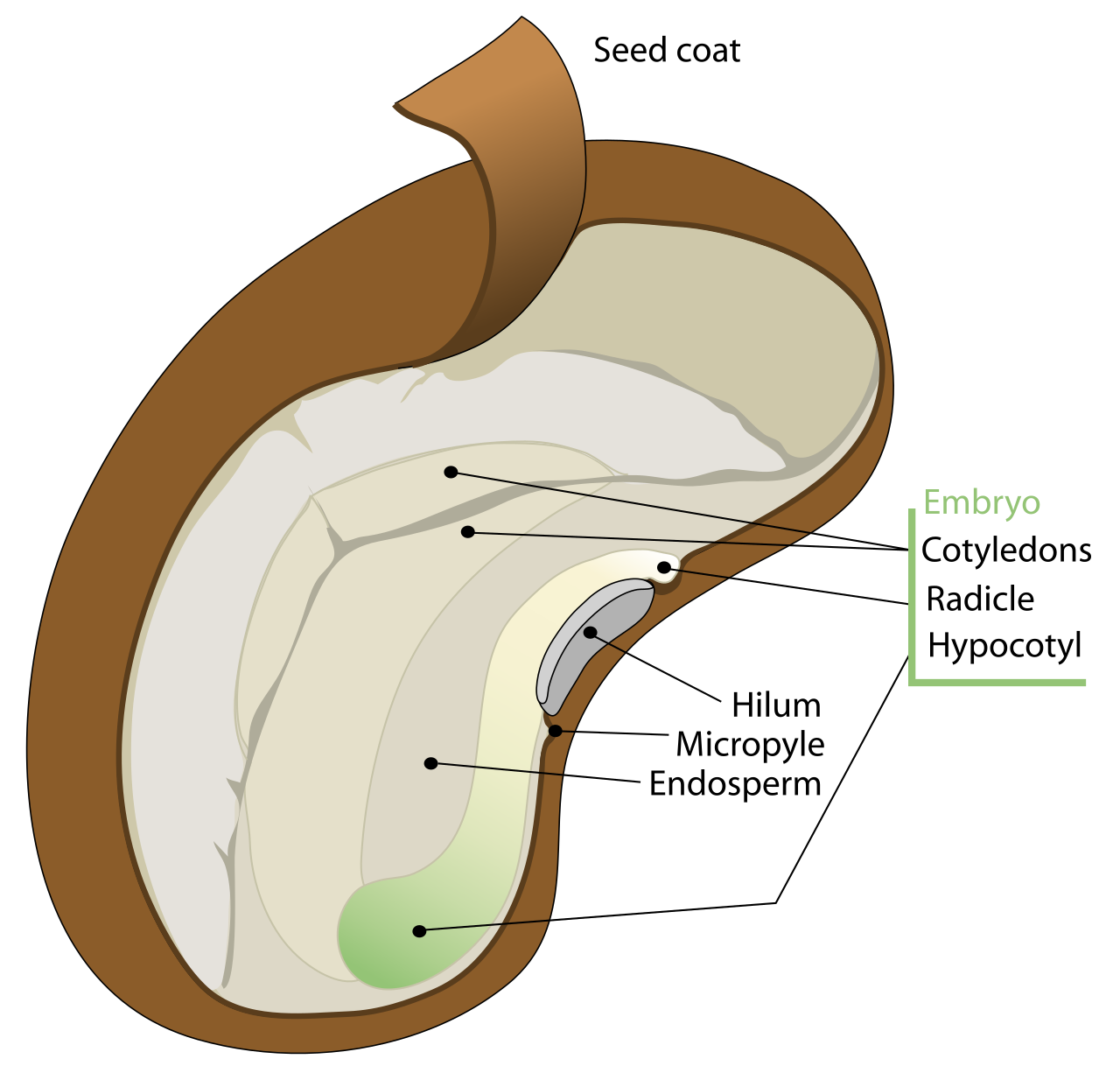
- Seed coat – The ovule is made up of two layers: the thick outer layer called the testa and the thin inner layer called the tegmen. It protects the embryo.
- Embryo – The tiny plant inside the seed, consisting of the embryonic root (radicle, which later becomes the root), the plumule (which later becomes the stem-leaf), and one or two cotyledons (which provide initial nutrition).
- Endosperm — A store of food stored for the embryo; in some seeds (e.g., pea, chickpea) it is absorbed by the cotyledons during embryonic development (these are called non-endospermic seeds), while in other seeds (e.g., maize, wheat, castor) it persists until the seed matures (these are called endospermic seeds).
🖼️ Internal structure of a dicotyledonous seed (such as a bean)
Dicot vs. Monocot Seeds
| Dicotyledonous seeds (e.g., chickpea, bean) | Monocot seeds (e.g., corn, wheat) |
|---|---|
| ◆ has two cotyledons ◆ Usually non-endospermic (food stored in cotyledons) ◆ Seeds of plants having reticulate venation ◆ Germination is usually epigeal (cotyledons emerge from the soil). | ◆ have a single cotyledon (called a scutellum) ◆ Usually endospermic (food stored in a separate endosperm) ◆ seeds of plants with parallel venation ◆ Germination is usually hypogeal (the cotyledons remain within the soil). |
Germination
On getting suitable water, temperature and oxygen, the seed breaks dormancy and starts germinating. Germination is of two types - Epigeal germination, in which the cotyledons come out of the soil, above the surface, due to the growth of the root hypocotyl and turn green and also perform photosynthesis for some time (e.g. beans, pumpkin), and underground germination (Hypogeal), in which the cotyledons remain inside the soil, and only the shoot comes up due to the growth of the epicotyl (e.g. peas, maize).
Quality and purity of seeds is the first condition for any good crop – that is why the Government of India and Rajasthan Agriculture Department encourage farmers to use certified seeds and improved varieties (High Yielding Varieties/HYV), so that both yield and quality can be improved.
◆ seed coat ◆ Testa ◆ Tegmen ◆ Embryo ◆ Cotyledons ◆ endosperm ◆ Epigeal germination ◆ Hypogeal germination
• The root is formed from the radicle, is geotropic and hydrotropic, and has two types: taproot (dicotyledonous) and taproot (monocotyledonous); it has four regions: the root cap, the meristematic zone, the elongation zone, and the maturation zone. • Roots are modified for functions such as food storage, photosynthesis, moisture absorption, parasitic nutrition, gaseous exchange and strong support – such as carrot (conical form), banyan (columnar root) and dodder (haustoria). • The stem is formed from the plumule, is phototropic, and has internodes and buds; it is modified into underground (potato, ginger, onion), semi-aerial (runner, stolon), and aerial (stem tendril, thorn, cactus) forms. • Dicotyledonous stems exhibit secondary growth (by cambium), producing annual rings, which are counted to determine the age of the tree (dendrochronology); monocotyledonous stems generally lack secondary growth. • The leaf is composed of the petiole, petiole, and lamina; the venation is reticulate (dicotyledonous) or parallel (monocotyledonous); it is the main site of photosynthesis, transpiration, and gaseous exchange, and may be modified into structures such as tendrils, spines, and insectivorous pitchers. • The flower is a modified shoot bearing four whorls—calyx, corolla, androecium, and gynoecium—arranged in succession; depending on the position of the ovary, it may be hypogynous, perigynous, or epigynous. • The inflorescence may be dioecious (acrophytic order, such as the raceme of mustard) or sesquipedic (acrophytic order, such as the monoecious raceme of cotton). • The fertilized ovary matures to form the true fruit, whose pericarp may divide into epicarp, mesocarp, and endocarp; the fruit may be simple (pea), compound (custard apple), or compound (pineapple). • The seed consists of the seed coat (testa-tegmen), the embryo (radicle-pistil-cotyledon), and the endosperm; germination may be epigeal (cotyledons emerge, as in beans) or hypogeal (cotyledons remain inside, as in peas). • Every part of a plant—from the root to the seed—is not limited to its basic function, but has the amazing ability to transform itself according to the challenges of the environment and perform new functions, which reflects nature's greatest adaptability.