- Agriculture of Rajasthan – Introduction, Importance and Characteristics
- Agro-Climatic Zones of Rajasthan
- Major Kharif crops – Millet, Jowar, Moong, Cluster Bean
- Major Rabi crops – wheat, mustard, gram, barley
- Cash crops – cotton and soybean
- Irrigation and water management – Indira Gandhi Canal and drip irrigation
- Horticulture – Major fruits (pomegranate, kinnow, plum, date palm)
- Horticulture – Vegetables and spices (fennel, cumin, coriander, garlic, chili)
- Forestry – Forest types and forest cover of Rajasthan
- Social Forestry and Agroforestry – Rajasthan Model
- Animal Husbandry – Major Cattle and Buffalo Breeds
- Animal husbandry – goat, sheep and camel breeds and wool industry
- Dairy Development – Saras Dairy (RCDF) and White Revolution
- Rajasthan's agricultural policies and future direction
Nearly 60 percent of Rajasthan is desert, rainfall is scanty, and temperatures reach 48 degrees Celsius in summer—yet Rajasthan is India's largest producer of mustard, millet, cluster beans, fennel, cumin, coriander, and psyllium. How is this possible? The answer lies in the farmers' centuries-old understanding of drought-tolerant farming, massive irrigation projects like the Indira Gandhi Canal, the arid-climate-friendly rearing of animals like camels and goats, and cooperative movements like Saras Dairy. This chapter is the story of Rajasthan's agricultural journey—the story of growing greenery in the sand.
1 Agriculture of Rajasthan – Introduction, Importance and Characteristics
Rajasthan is India's largest state by area (about 10.4% of the total), but its climate is considered one of the most challenging in the country – the average annual rainfall is only 574 mm (much lower than the national average of 1,100 mm), and about 60% of the state falls in the arid and semi-arid category. Despite this, agriculture and animal husbandry are the backbone of Rajasthan's rural economy – about 62% of the state's population is directly or indirectly dependent on agriculture and allied sectors, and the agriculture and animal husbandry sectors contribute about 25-26% to the state's gross domestic product (GSDP).
The most significant characteristic of Rajasthan's agriculture is "unity in diversity." While the extremely dry desert regions of Barmer and Jaisalmer are home to rain-fed millet and mung beans, canal-irrigated areas like Sri Ganganagar and Hanumangarh are home to abundant cash crops like wheat, cotton, and mustard. This is why Rajasthan is considered one of the states with the greatest agro-climatic diversity in India.
Salient features of agriculture in Rajasthan
- Rainfall dependence – About 60% of the state's agricultural area is still under unirrigated (rain-fed) farming, especially during the Kharif season.
- Predominance of coarse grains – Millet is the most important Kharif crop of Rajasthan, Rajasthan has the largest share in the total millet production of India.
- National leadership in spice production – Rajasthan is leading in India in the production of spices and medicinal crops like cumin, fennel, coriander, fenugreek, isabgol.
- Livestock-based economy – Rajasthan is one of the leading states in India in terms of livestock population, especially in goat, sheep and camel rearing.
- Traditional water conservation techniques – Centuries-old water harvesting systems like Khadin, Tanka, Nadi, Kund, Johad still support agriculture in dry areas.
Farmers in western Rajasthan use a traditional technique called 'Khadin' – a structure that traps rainwater flowing down hill slopes in the fields by creating earthen bunds, allowing soil moisture to remain in the soil for a longer period and allow crops like wheat or gram to be grown without additional irrigation – this technique has been prevalent in the Jaisalmer region for centuries.
Rajasthan is the only state in India that, despite its desert conditions, contributes significantly (about 8-9%) to the country's total food grain production – a testament to the drought-management capabilities of its farmers.
◆ Agro-climatic diversity ◆ rain-fed farming ◆ Khadin ◆ GSDP contribution ◆ coarse grains ◆ water harvesting
2 Agro-Climatic Zones of Rajasthan
The Indian Council of Agricultural Research (ICAR) and Rajasthan Agricultural Universities have divided Rajasthan into 10 agro-climatic zones based on variations in soil, rainfall, temperature, and cropping patterns. This classification is extremely useful in agricultural planning, selecting appropriate crops, and determining irrigation policies—scientists rely on this classification when recommending crops for a given region.
| Area | Major districts (examples) | Main Feature |
|---|---|---|
| I. Dry Western Plains | Jaisalmer, Barmer (partial) | Very low rainfall (100-300 mm), sandy soil, millet dominant |
| II. Irrigated North-Western Plains | Sri Ganganagar, Hanumangarh | Irrigated by the Indira Gandhi Canal, wheat, cotton and mustard are the main crops. |
| III. Interriver Plains | Jaipur, Ajmer (partial) | Moderate rainfall, mixed farming |
| IV. Dry semi-desert plains | Nagaur, Churu, Bikaner | Dry millet-mung-cluster bean |
| V. Humid Southern Plains | Udaipur, Dungarpur, Banswara | Relatively high rainfall, maize dominated |
| VI. Humid South-Eastern Plains | Kota, Bundi, Jhalawar | Black soil (Malwa Plateau influence), soybean-wheat |
| VII. The Semi-Arid Eastern Plains | Bharatpur, Dhaulpur, Karauli | Moderate rainfall, millet-mustard-wheat |
| VIII. Flood Plains (Chambal Command) | Kota, Baran | Chambal canal irrigated, wheat and paddy |
| IX. Semi-arid southern plains | Sirohi, Pali (partial) | Abu mountain influence, fruits and vegetables |
| X. Humid southern plateau region (Mewar) | Udaipur plateau region | Forested, maize-wheat |
Region II (Sriganganagar-Hanumangarh) is often called the 'granary of Rajasthan', because the irrigation facilities of the Indira Gandhi Canal have made Green Revolution farming like that of Punjab and Haryana possible here – wheat productivity here is almost double the state average.
◆ Agro-climatic zones ◆ ICAR classification ◆ 10 areas ◆ cropping pattern ◆ Soil diversity
3 Major Kharif crops – Millet, Jowar, Moong, Cluster Bean
Pearl Millet
Millet (scientific name:Pennisetum glaucus) is the most important Kharif crop of Rajasthan. It is a highly drought-tolerant millet that yields well even in low rainfall and sandy soils. Rajasthan leads in millet production in India – more than 40% of the country's total millet production comes from Rajasthan alone. Nagaur, Barmer, Jodhpur, Churu, Jaipur and Sikar are the major millet producing districts.
The year 2023 was declared the 'International Year of Millets' by the United Nations – in this campaign, Rajasthan's millet was specifically promoted as a 'superfood' because it is rich in protein, fibre and iron and is also a climate-resilient crop.
Sorghum
Sorghum (scientific name:Sorghum bicolor) is also a major coarse grain grown for both grain and fodder. It requires slightly more moisture than millet, so it is grown primarily in eastern and southern Rajasthan (Kota, Bundi, Chittorgarh).
Green Gram / Moong
Mung bean (scientific name:Radiated vineyard) is a legume crop that matures in a short time (60-70 days) and also improves soil fertility by fixing nitrogen in the soil. Rajasthan is one of the leading states in mung bean production in India, especially in central and western Rajasthan (Nagaur, Jodhpur, Pali).
Cluster Bean / Guar
Guar (scientific name:Cyamopsis tetragonoloba) is a distinctive and economically very important crop of Rajasthan. Rajasthan is the leading producer of guar in the world – India produces about 80% of the total guar production of the world, and Rajasthan has the largest share (more than 70%) in this. Guar Gum, extracted from guar seeds, is a valuable industrial product used as a thickening agent in the food industry, textile industry and especially in the petroleum and shale gas extraction (Fracking) industry.
During the expansion of the shale gas/fracking boom in the US, international demand for guar gum increased so much that guar farmers in the Bikaner and Jodhpur regions received exceptionally high prices – this was called the 'guar boom' in the media.
| Crop | scientific name | Situation in Rajasthan |
|---|---|---|
| Millet | Pennisetum glaucus | First in production in India (about 40%+) |
| tide | Sorghum bicolor | mainly in the south-eastern region |
| Mung Beans | Radiated vineyard | Among the leading producing states |
| Guar | Cyamopsis tetragonoloba | Highest production in the world (about 70%+) |
◆ Millet ◆ tide ◆ Mung Beans ◆ Guar ◆ coarse grains ◆ guar gum ◆ nitrogen fixation
4 Major Rabi crops – wheat, mustard, gram, barley
Mustard/Rapeseed
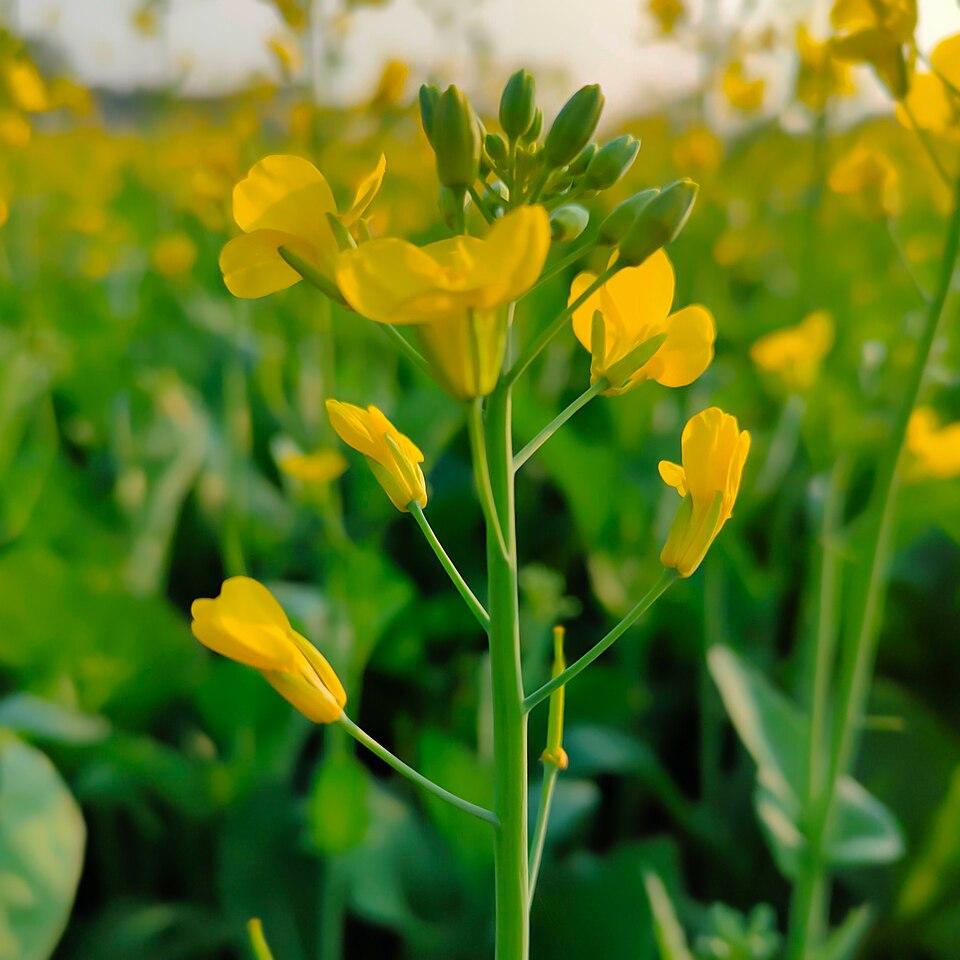
Mustard (scientific name:Brassica juncea) is the most important Rabi oilseed crop of Rajasthan. Rajasthan leads in mustard production in India – about 45-48% of the country's total mustard-rapeseed production comes from Rajasthan alone. Bharatpur, Alwar, Dausa, Tonk, Sriganganagar and Bhilwara are the major producing districts. Mustard oil is the main edible oil in most households in North India, including Rajasthan, and mustard cake is used as animal feed.
🖼️ A blooming mustard flower – the main Rabi oilseed crop of Rajasthan (Image: Wikimedia Commons)
Wheat
Wheat (scientific name:Summer wheat) is the major food grain crop of Rajasthan, especially in irrigated areas. In canal- or tubewell-irrigated districts such as Sri Ganganagar, Hanumangarh, Kota, Bundi, and Alwar, wheat productivity is nearly equal to or even higher than the national average. Wheat requires substantial irrigation (3-4 times), so its cultivation is concentrated primarily in areas where canal or groundwater irrigation is available.
Chickpeas (Gram)
Chickpea (scientific name:Chickpea) is a legume rabi crop that yields well even with relatively little water, so it is widely grown in unirrigated and semi-irrigated areas (around Kota, Bundi, Baran, and Jhalawar). Rajasthan is one of India's major chickpea-producing states.
Barley
Barley (scientific name:Barley) is the most drought-tolerant rabi grain, which can be grown even in saline and low-fertile soils. It is a suitable choice for the dry and marginal land areas of Rajasthan, and is used for both malt (in the brewery industry) and animal feed.
A special variety of mustard, 'RH-725' and 'Pusa Bold', is widely grown in Rajasthan as it gives good yield even in less water – agricultural scientists have developed these varieties especially keeping in mind the dry climate of Rajasthan.
◆ Mustard ◆ Wheat ◆ Gram ◆ barley ◆ Winter crops ◆ oilseeds ◆ pulses
5 Cash crops – cotton and soybean
Cotton (scientific name:Gossypium hirsutum) is an important cash crop of Rajasthan, grown extensively mainly in the Sri Ganganagar-Hanumangarh region due to the irrigation facility of the Indira Gandhi Canal. Bt cotton (a genetically modified insect-resistant variety) discussed in Chapter 10 has also been widely adopted in Rajasthan, significantly reducing losses caused by the bollworm pest (see Chapter 10 for detailed technical details).
Soybean (scientific name:Glycine max) is a relatively new but rapidly gaining popularity as a Kharif cash crop in Rajasthan, especially in the black soil of the Kota-Bundi-Jhalawar region, which has agro-climatic conditions similar to those of Madhya Pradesh. This region is therefore sometimes called the "Soy State of Rajasthan."
| Cotton | Soybean |
|---|---|
| ◆ Major canal irrigated areas in the north-western region ◆ The Bt cotton variety has been widely adopted. ◆ raw materials for the textile industry | ◆ Predominant in the black soil of Kota-Bundi-Jhalawar ◆ Useful in both edible oil and animal feed ◆ A relatively new but rapidly growing crop |
◆ cotton ◆ Soybean ◆ cash crop ◆ Bt cotton ◆ black soil
6 Irrigation and Water Management – Indira Gandhi Canal and Drip Irrigation
Irrigation is the key to Rajasthan's agricultural success. Because rainfall is highly erratic and low across much of the state, canals, tube wells, and modern micro-irrigation techniques have played a crucial role in transforming desert into cultivable land.
Indira Gandhi Canal Project
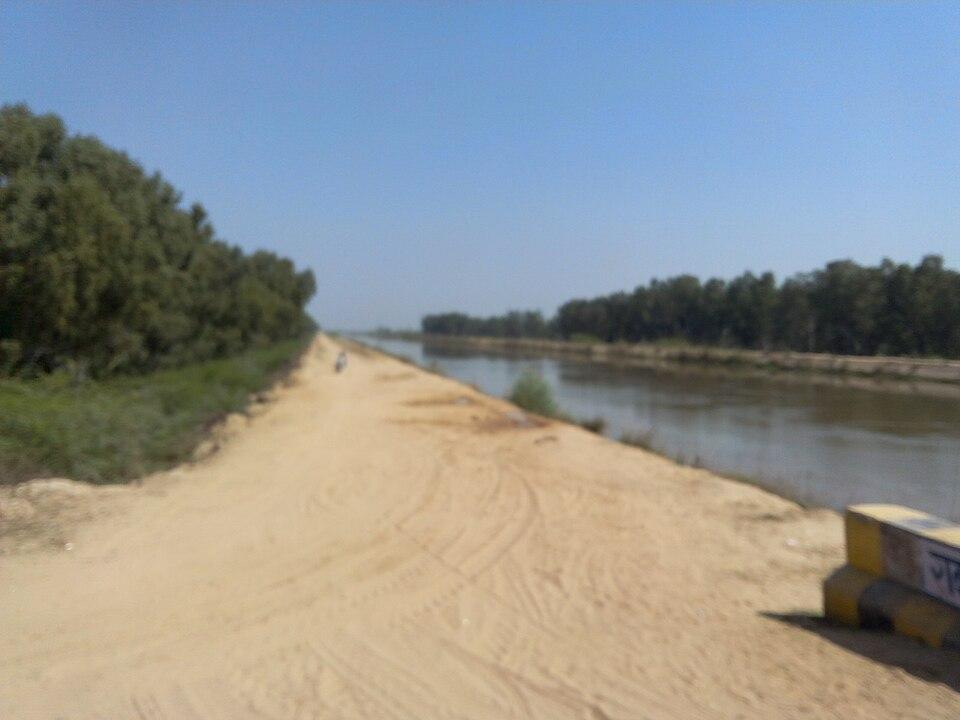
The Indira Gandhi Canal (originally known as the Rajasthan Canal) is one of India's longest irrigation canals, with a total length of approximately 649 kilometers. It carries water from the Harike Barrage in Punjab and irrigates vast arid areas in the districts of Sri Ganganagar, Hanumangarh, Bikaner, and Jaisalmer. The canal has transformed large parts of the Thar Desert, once covered in sand dunes, into lush green fields – now cultivated with wheat, cotton, mustard, and even rice.
🖼️ Indira Gandhi Canal, near Rawatsar – flowing through the Thar Desert (Image: Wikimedia Commons)
Drip Irrigation
Where canal irrigation is not available, the Rajasthan government is promoting micro-irrigation techniques—particularly drip and sprinkler irrigation. These techniques deliver water drop by drop directly to the plant's roots, saving 40-60% of water compared to conventional irrigation. Under the state government's Pradhan Mantri Krishi Sinchai Yojana (PMKSY), farmers are provided substantial subsidies for installing drip and sprinkler sets.
Farmers in Sri Ganganagar district often say, 'The canal has turned the desert into Punjab' – a saying that accurately reflects the impact of the Indira Gandhi Canal, as the farming pattern in the canal-irrigated area has become similar to that of Punjab and Haryana, while the unirrigated area just a few kilometres away still depends on desert farming.
Excessive irrigation in the Indira Gandhi Canal area has also led to waterlogging and salinity problems at some places – hence scientists are now laying more emphasis on balanced and micro-irrigation methods.
◆ Indira Gandhi Canal ◆ drip irrigation ◆ PMKSY ◆ waterlogging ◆ micro-irrigation
7 Horticulture - Major fruits of Rajasthan (pomegranate, kinnow, plum, date palm)
Horticulture is a rapidly growing sector of Rajasthan's agricultural economy, especially in areas where traditional grain farming is less profitable. Certain fruit crops are being grown very successfully even in arid climates, providing farmers with far greater economic returns than cereal crops.
Pomegranate
Pomegranate (scientific name:Pomegranate) is grown extensively in Rajasthan, especially in the districts of Jodhpur, Barmer, Nagaur, and Pali. Due to its high yield even with limited water, pomegranate has become extremely popular among farmers in dry areas, and Rajasthan is now considered one of India's leading pomegranate-producing states.
Kinnow/Orange
Kinnow is a hybrid citrus fruit grown extensively in the Sri Ganganagar and Hanumangarh districts thanks to canal irrigation—Sriganganagar is often called the "Kinnow Capital of Rajasthan." Kinnows grown here are renowned nationwide for their juiciness and sweetness.
Ber (Indian Jujube)
plum (scientific name: Ziziphus mauritiana) is a highly drought-tolerant fruit, ideal for arid regions. Improved varieties such as 'Gola', 'Seba Ber', and 'Umran', developed by the Central Arid Zone Research Institute (CAZRI), Jodhpur, are popular with farmers in Rajasthan.
Date Palm
Date palm (scientific name:Phoenix dactyliferaCultivation of ) is relatively new but rapidly growing in Rajasthan, especially in the Bikaner and Jaisalmer regions, where the climate is similar to that of Gulf countries (e.g., Saudi Arabia, Iraq). Improved varieties such as Barhi and Medjool are being planted through tissue culture plants.
| Fruit | scientific name | Major districts |
|---|---|---|
| Pomegranate | Pomegranate | Jodhpur, Barmer, Nagaur, Pali |
| Kinnow | hybrid citrus | Sri Ganganagar, Hanumangarh |
| Berry | Ziziphus mauritiana | entire dry area |
| Dates | Phoenix dactylifera | Bikaner, Jaisalmer |
◆ Pomegranate ◆ Kinnow ◆ Berry ◆ Dates ◆ CAZRI Jodhpur ◆ Horticulture
8 Horticulture – Major vegetables and spices of Rajasthan
Rajasthan is India's most diverse spice-producing state—it produces a wide range of spices and medicinal crops, including cumin, fennel, coriander, fenugreek, garlic, and chili. These crops offer high economic value even with relatively low water requirements, making them particularly beneficial for farmers in arid regions.
Fennel
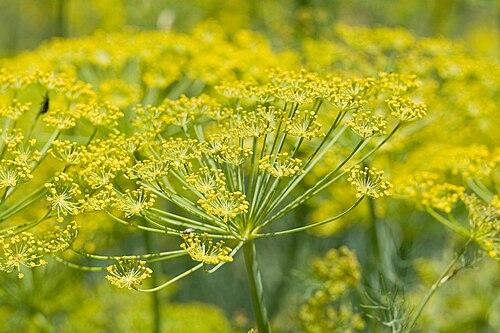
Fennel (scientific name:Common fennelRajasthan holds a near-monopoly in the production of fennel in the country—about 90% of India's total fennel production comes from Rajasthan alone. Bilara (Jodhpur), Nagaur, Lalsot, and Sirohi (Abu region) are the major producing areas. The drought-tolerant variety 'Abu Fennel-440' developed by the Krishi Vigyan Kendra, Sirohi, has already been discussed in the Biotechnology chapter (Chapter 10) as an example of plant breeding—it is worth noting that this variety was developed specifically for the low rainfall conditions of Rajasthan.
🖼️ Fennel flowers — Rajasthan produces about 90% of India's total fennel production (Image: Wikimedia Commons)
Cumin
Cumin (scientific name:Cumin, cumin) is another major spice of Rajasthan. In recent years, Gujarat has overtaken Rajasthan in cumin production, yet Rajasthan remains one of the largest cumin-producing states in the country, contributing about 14% of the national output. Nagaur, Jodhpur, and Barmer are the major cumin-producing districts.
Coriander, fenugreek, garlic and chilli
- Coriander – Grown extensively in Kota-Baran division, Rajasthan is among the leading states in its production in the country.
- Fenugreek – Nagaur district is especially famous for the production of fenugreek, also a drought-tolerant spice crop.
- Garlic – It is grown mainly in Kota, Baran and Jhalawar areas.
- Chilli – Jodhpur's 'Mathania Chilli' is famous across the country for its unique spiciness and taste, it has received Geographical Indication (GI Tag).
Isabgol (Psyllium)
Isabgol (scientific name:Plantago ovata) is a medicinal crop used as a laxative and fiber supplement. Rajasthan is the largest producer of psyllium in India, with Jalore and Barmer districts being major centers of its cultivation. India accounts for the majority of the world's total psyllium production and export, with Rajasthan contributing the most.
| Spice/Medicinal Crop | National status of Rajasthan | Major districts |
|---|---|---|
| Fennel | About 90% of production is in India | Bilara, Nagaur, Sirohi |
| Cumin | In leading states (about 14%) | Nagaur, Jodhpur, Barmer |
| Coriander | Leading producing states | Kota, Baran |
| Psyllium hydrangea | First in India | Jalore, Barmer |
Rajasthan can be called the 'Spice Bowl of India' because it ranks at or near the top in the country in many crops like cumin, coriander, fennel, fenugreek and psyllium.
◆ Fennel ◆ Cumin ◆ Psyllium hydrangea ◆ Mathania Mirch ◆ GI tag ◆ spice stores
9 Forestry – Forest types and forest cover of Rajasthan
The total forest cover of Rajasthan is about 4.87% of the state's geographical area (according to the Forest Survey of India report, India State of Forest Report) – this is much lower than the national average (about 21%), a natural consequence of the state's dry climate. Nevertheless, Rajasthan is not short of forest diversity – from the evergreen forests of the Aravalli range to the sparse thorny scrub of the Thar Desert, a wide variety of forests are found here.
Major forest types of Rajasthan
- Tropical Dry Deciduous Forest – Found in Southern Rajasthan (Udaipur, Banswara, Dungarpur), trees like teak and sal are found here.
- Tropical Thorn Forests – Found in most of the dry parts of the state, drought-tolerant species like Khejri, Babul, Rohida are prominent among them.
- Aravalli forests – Relatively dense forests are found in the Sariska and Mount Abu areas, which are rich in biodiversity (see Chapter 14 for details).
- Desert Scrub – Scattered vegetation of Fog, Sevan grass and Khejri is found in the Jaisalmer-Barmer region.
Khejri (scientific name:Prosopis cineraria) is the state tree of Rajasthan, known as the "Kalpavriksha of the Desert"—the only tree that remains green even in extremely dry conditions and provides fodder, fuel, and shade to the local people. Sangri, made from its pods, is an essential part of the Rajasthani Panchkuta dish.
In 1730 AD, in Khejarli village of Jodhpur, 363 Bishnoi community members, led by Amrita Devi Bishnoi, sacrificed their lives to save Khejri trees from being cut down – this incident is considered one of the earliest and most influential environmental conservation movements in the world, and also inspired the modern Chipko movement.
◆ forest cover ◆ dry deciduous forests ◆ thorny forest ◆ Khejri ◆ Amrita Devi Bishnoi ◆ State tree
10 Social Forestry and Agroforestry – Rajasthan Model
Since the natural forest cover in Rajasthan is limited, special priority has been given to 'Social Forestry' and 'Agroforestry' in the state – their objective is to increase the green cover by promoting tree plantation on government land, community land and private agricultural land, as well as to provide fuel, fodder and additional source of income to the villagers.
Agroforestry – Rajasthan Model
Farmers in Rajasthan have traditionally grown trees like Khejri, Babul, and Rohida on the boundaries and in the middle of their fields—a practice known as the Khejri-based agroforestry system. This is an ancient yet scientifically proven technique, as crops (such as millet or mung beans) grown under Khejri trees have been found to yield higher yields than those grown in open fields—this is because Khejri trees draw moisture from the groundwater table through their deep roots and fertilize the soil by shedding leaves, while their umbrella-shaped structure doesn't cast much shade on the crops.
Social Forestry Programme
- Forest Department, Rajasthan runs tree plantation drives on roadsides, canal banks, railway tracks and community pasture lands.
- Under campaigns like 'Hariyalo Rajasthan', tree plantation has been encouraged on a large scale in the state.
- Tree plantation and forest protection works have also been included under MNREGA, due to which both the goals of employment and environmental protection are achieved simultaneously.
Agroforestry is particularly suitable for Rajasthan because it provides additional income (timber, fodder) to the farmer and also prevents soil erosion – soil erosion is a serious problem in the arid region, which the roots of trees help prevent.
◆ Social Forestry ◆ Agroforestry ◆ Khejri based system ◆ Green Rajasthan ◆ soil erosion
11 Animal Husbandry – Major cattle and buffalo breeds of Rajasthan
Rajasthan is one of the leading states in India in terms of livestock population (according to the 20th Livestock Census, the state has a total livestock population of approximately 78.7 million). In arid climates, when crop production is risky, animal husbandry emerges as a stable and reliable source of income for farmers—hence the importance of animal husbandry to Rajasthan's rural economy, as much as crop production, sometimes even more so.
Major Cattle Breeds
- Tharparkar – Originally a breed from the Jaisalmer-Barmer region (Thar-Parkar region), it is a dual-purpose (both milk and labour) and highly drought-tolerant breed, whitish-brown in colour.
- Rathi – Breed of Bikaner-Sriganganagar region, it is especially famous for milk production, gives good milk even with less fodder.
- Nagauri – Breed of Nagaur region, especially famous for labour/farm work (as bullock), known for its fast speed and strong body.
- Kankrej – Breed from Jalore-Barmer region bordering Gujarat, this is also a strong dual purpose breed.
Buffalo Breeds
The Murrah buffalo is primarily a Haryana-Punjab breed, but is also widely reared in the Hanumangarh-Sriganganagar region of Rajasthan, as it is considered one of the best milk-producing buffalo breeds in the world. The Bhadawari buffalo is a local breed of the Dholpur-Karauli region (Chambal River belt), known for its high fat percentage in milk.
| breed | Type | key areas | Speciality |
|---|---|---|---|
| Tharparkar | cattle | Jaisalmer, Barmer | Dual-use, drought-tolerant |
| Rathi | cattle | Bikaner, Sriganganagar | high milk production |
| Nagauri | cattle | Nagaur | Famous for labor |
| Murrah | Buffalo | Hanumangarh, Sri Ganganagar | Best Milk Buffalo in the World |
| Bhadawari | Buffalo | Dhaulpur, Karauli | high fat milk |
◆ Tharparkar ◆ Rathi ◆ Nagauri ◆ Kankrej ◆ Murrah Buffalo ◆ Bhadawari Buffalo
12 Animal Husbandry – Goat, Sheep and Camel Breeds and Wool Industry
Goat Breeds
Rajasthan is one of the leading states in India in terms of goat population. The Marwari goat is a common breed in western Rajasthan, while the Sirohi goat (a breed from Sirohi district) is renowned nationwide for its meat production and fast growth rate, and is considered one of the best meat breeds in India. The Jakharana goat (Alwar region) is particularly known for its milk production.
Sheep Breeds
Rajasthan is one of the leading wool producing states in India—about 40–45% of the country's total wool production comes from Rajasthan alone. The Chokla sheep (Churu-Jhunjhunu region) is renowned for its excellent wool quality, while the Marwari sheep (Jodhpur-Barmer region) is the most widely reared breed. The Magra sheep (Bikaner region) also produces good quality wool.
Camel – State animal of Rajasthan
Camel (scientific name:Dromedary camel) has been declared the state animal of Rajasthan—it has been indispensable for centuries in transportation, agriculture, and tourism in the arid region, hence its nickname "Ship of the Desert." The Bikaneri camel is renowned for its large size and load-carrying capacity, while the Jaisalmeri camel is known for its speed and is used for both military and tourism purposes.
🖼️ A decorated camel at the Pushkar Fair – the state animal of Rajasthan (Image: Wikimedia Commons)
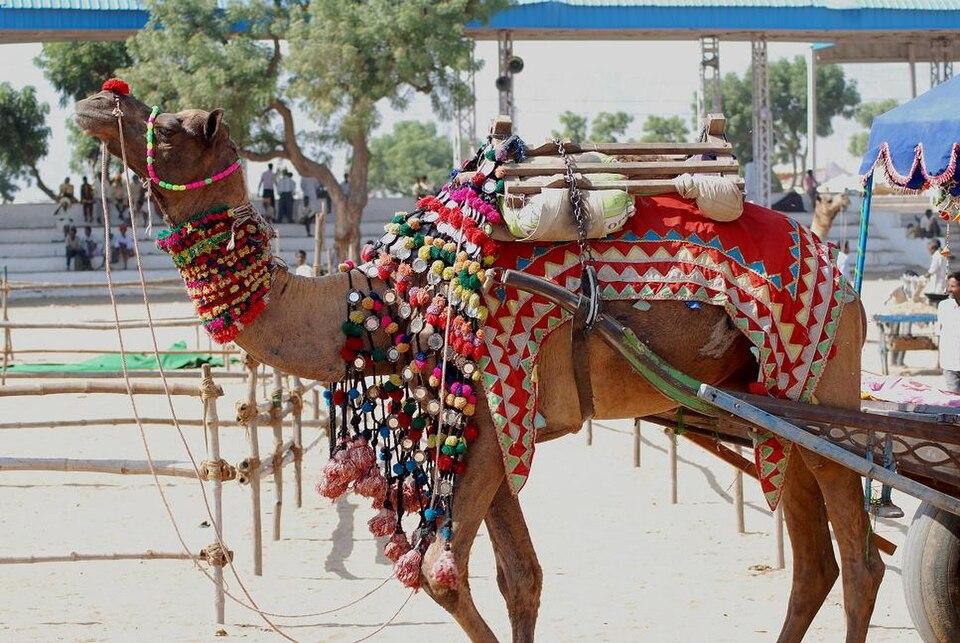
Rajasthan has witnessed a significant decline in camel numbers—from approximately 746,000 in 1992 to approximately 213,000 today, a decline of approximately 71%. The increasing use of tractors and vehicles has reduced the camel's agricultural value. Given this dire situation, the camel is being considered for listing on the IUCN Red List as Critically Endangered.
To arrest this decline, the Rajasthan government has taken two important steps. First, the Rajasthan Camel (Prohibition of Slaughter and Regulation of Temporary Migration or Export) Act, 2015 – this prohibits camel slaughter and inter-state illegal trade, to prevent smuggling. Second, the Camel Development Scheme – launched on October 2, 2016, provides assistance of ₹10,000 to camel breeders for the birth of each calf, to ensure camel rearing remains economically viable.
An interesting paradox is that while the prohibition of slaughter laws curbed illegal trafficking, the ban also curbed the legal trade of camels, leading to a decline in market prices—making camel rearing less economically attractive for some herders. This demonstrates the need to consider economic considerations when formulating wildlife/livestock conservation policies.
◆ Sirohi goat ◆ Chokla Sheep ◆ Marwari sheep ◆ Bikaneri camel ◆ Jaisalmer camel ◆ Camel Development Scheme ◆ State animal
13 Dairy Development – Saras Dairy (RCDF) and White Revolution
The Rajasthan Cooperative Dairy Federation (RCDF), branded as 'Saras', was established in 1977. Following the footsteps of Gujarat's renowned 'Amul Model (Anand Pattern),' it is the primary organization implementing dairy development in Rajasthan. Its objective is to organize small and marginal milk producers, secure fair prices for them, and establish a well-organized chain for processing and marketing milk and milk products.
Three-tier cooperative structure
- Village level – Dairy Cooperative Societies (DCS), where farmers directly deposit their milk.
- District level – District Milk Unions, which collect milk from village committees and process it.
- State level – RCDF, which coordinates, branding (Saras) and marketing the entire network.
Currently, the Saras Dairy network comprises over 15,000 village-level milk cooperatives, connecting approximately 800,000 milk producers, and 21 district milk unions covering almost all districts of the state. Rajasthan currently produces approximately 45 million liters of milk per day, of which approximately 50% is marketable surplus that reaches the market through cooperative networks like Saras.
When a rural woman deposits her buffalo milk every morning at the village dairy cooperative society and receives immediate or regular payment in return, the entire system is a living example of the 'White Revolution' – the cooperative model started by Dr. Verghese Kurien in Gujarat, successfully adapted by Rajasthan to suit its own circumstances.
◆ Saras Dairy ◆ RCDF ◆ Ananda Pattern ◆ White Revolution ◆ Milk Co-operative Society ◆ Three-tier structure
14 Rajasthan's agricultural policies and future direction
Keeping in mind the future challenges – climate change, depleting groundwater levels, increasing population pressure – the Rajasthan government is implementing several far-reaching agricultural policies aimed at making agriculture more sustainable, profitable and climate-friendly.
Organic Farming
The Rajasthan government is promoting organic farming in the state, especially in areas where chemical fertilizer use has been relatively low (such as the tribal areas of southern Rajasthan). Under the Paramparagat Krishi Vikas Yojana (PKVY), farmers are provided training and financial assistance to adopt organic farming, which improves both soil quality and long-term productivity.
Agricultural Exports and Value Addition
Rajasthan exports its spices (cumin, fennel, coriander), guar gum, and psyllium on a large scale. Under the "Agricultural Export Policy," the government is promoting spice parks, agro-processing industries, and cold chain infrastructure, so that farmers can earn higher prices by selling processed products rather than raw materials.
Integration of solar energy and agriculture
Rajasthan is a leading state in solar energy production in India, and this advantage is also being utilized in the agricultural sector – solar pumps are being provided to farmers under the 'PM-KUSUM scheme', which reduces dependence on diesel, reduces irrigation costs, and also provides additional income to the farmers by selling surplus electricity.
groundwater conservation
Over-extraction of groundwater is a serious concern in Rajasthan, especially in areas where canal irrigation is not available. Under schemes such as the "Chief Minister's Water Self-Reliance Campaign," ponds, anicuts, and water harvesting structures are being renovated to maximize rainwater harvesting and reduce pressure on groundwater levels.
Experts believe that the future of Rajasthan's agriculture lies in the triangle of 'water-efficient crops + solar energy + value addition' — promoting low-water but high-value crops like coarse grains and spices, using solar energy for irrigation, and selling processed products instead of raw produce — this will keep Rajasthan's agriculture sustainable and profitable in the long run.
◆ organic farming ◆ PKVY ◆ PM-KUSUM ◆ Agricultural Export Policy ◆ Water Self-Reliance Campaign ◆ value addition
• Rajasthan is the largest state in India, with 60% of the area being arid/semi-arid, yet agriculture and animal husbandry contribute about 25-26% to the state's GSDP. • The state has been divided into 10 agro-climatic zones based on its climate-soil diversity, which helps in crop selection and irrigation planning. • Major Kharif crops – Millet (first in India), Jowar, Moong and Guar (highest production in the world, Guar gum is used in fracking industry). • Major Rabi crops – Mustard (about 45-48% production in India), wheat, gram and barley. • Cotton (including the Bt variety) and soybean are the major cash crops, concentrated in the canal-irrigated northwest and the black soil southeast regions, respectively. • The Indira Gandhi Canal (649 km) made large parts of the Thar Desert cultivable, while drip irrigation is a modern water-saving technique. • Pomegranate, Kinnow, Plum and Dates in Horticulture and Fennel (90% national production), Cumin and Isabgol (National First) in Spices are the special identity of Rajasthan. • The forest cover is only 4.87%, yet Khejri (state tree, 'Kalpavriksha of the Desert') based agroforestry and the sacrifice of Amrita Devi Bishnoi are symbols of the forest culture of Rajasthan. • In animal husbandry, Tharparkar-Rathi (cattle), Murrah-Bhadawari (buffalo), Sirohi (goat), Chokla (sheep) and camel (state animal, 71% population decline, Camel Development Scheme) are prominent. • Saras Dairy (RCDF, 1977) is a three-tier cooperative structure based on the Amul model, connecting 8 lakh+ milk producers and is a living example of the White Revolution. • The future direction of Rajasthan's agriculture – a combination of organic farming, PM-KUSUM solar pumps, agricultural exports and groundwater conservation To make it sustainable.